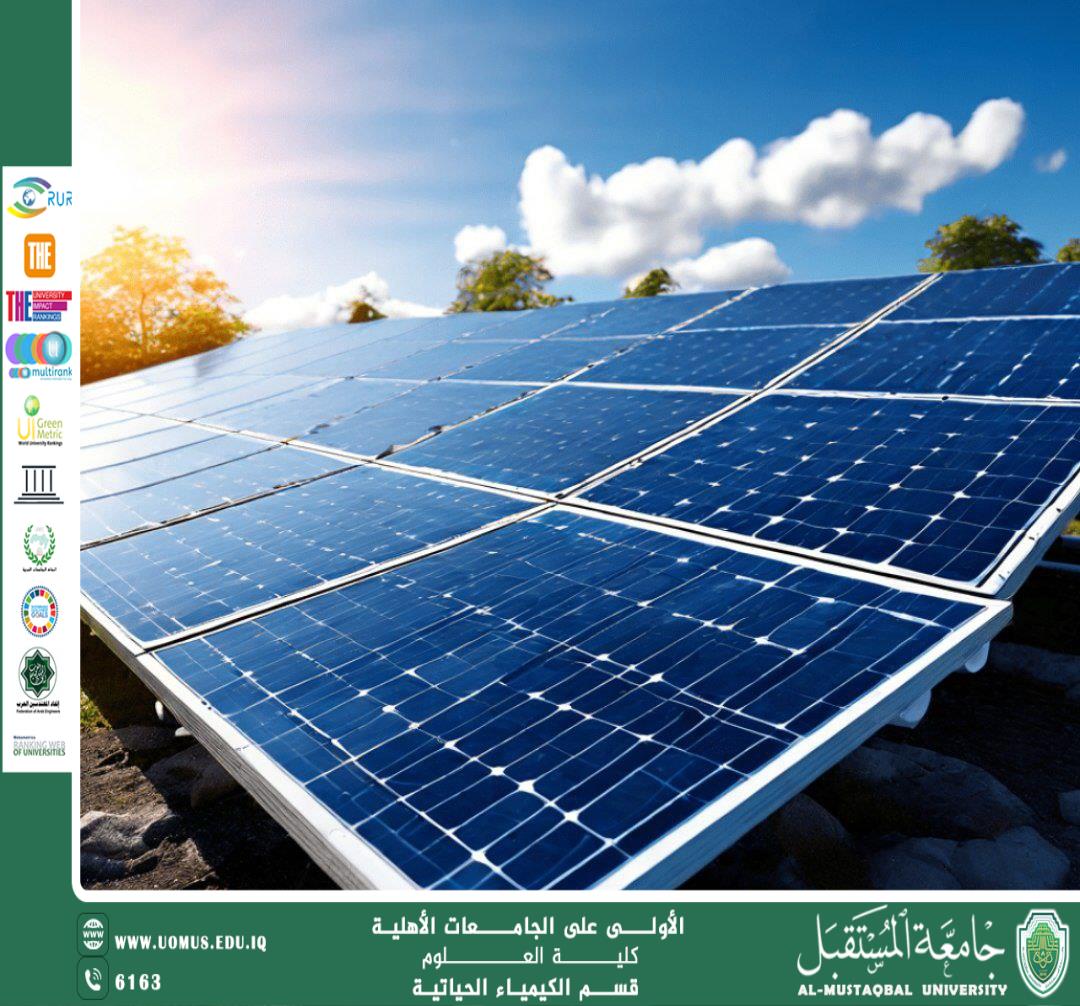
A scientific article for Lecturer M.M. estabraq Arif Mohammad entitled: The Chemistry Behind Solar Cells: How is Light Converted into Electric Current?
When we look at shiny glass solar panels, they may seem like purely technological pieces. However, at the core of their operation lies a fascinating chemical story; a story about absorbing light, liberating electrons, and generating an electric current. This article highlights the chemical principles that make solar cells work.
1. The Fundamental Material: Semiconductors
Most solar cells are based on materials called "semiconductors", the most famous of which is the element Silicon (Si), forming the backbone of over 90% of cells produced globally.
· Atomic Structure: Silicon is characterized by having four electrons in its outer shell, allowing it to form four covalent bonds with adjacent silicon atoms, thus creating a stable crystalline structure.
· Energy Band Gap: What chemically distinguishes semiconductors is the existence of what is called the "energy band gap" – a specific energy range that electrons need to break free from the covalent bond and move to the conduction band where they become free to move.
2. Doping: Engineering the Electric Cell
Pure silicon (called "intrinsic silicon") is a weak conductor of electricity. This is where precise chemistry comes into play through a process called "doping", where specific atomic impurities are intentionally introduced to change the electrical properties of the material.
· Negative Region (N-type): Silicon is "doped" with atoms that have five electrons in their outer shell, such as Phosphorus (P). Four of these electrons participate in forming bonds, while the fifth electron remains relatively "free," increasing the concentration of free electrons and making the predominant charge in this region negative.
· Positive Region (P-type): Silicon is "doped" with atoms that have three electrons in their outer shell, such as Boron (B). This results in a deficiency of one electron for bond formation, creating what is called a "hole", which behaves like a positive charge. The predominant charge here is positive.
3. The P-N Junction: The Heart of the Reaction
When the P-region and the N-region are joined together, a series of chemical-physical processes occur at the meeting point, known as the "P-N Junction".
· Charge Diffusion: Some free electrons from the N-region (rich in electrons) move to fill some holes in the P-region (rich in holes).
· Formation of the Electric Field: This migration creates a region around the junction called the "depletion region", where the N-side becomes slightly positive (from losing electrons
Al-Mustaqbal University - Ranked First Among Iraqi Private Universities