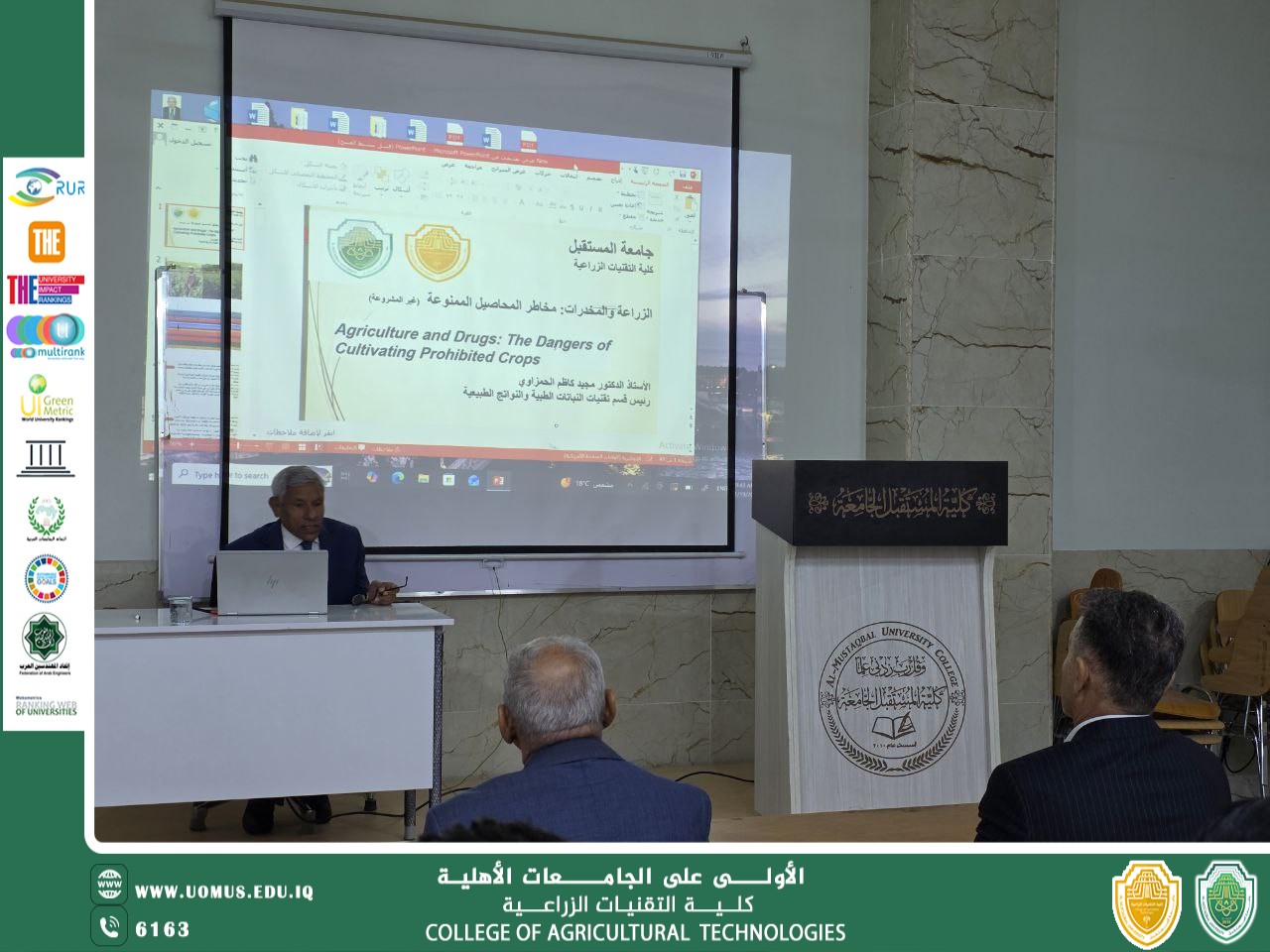
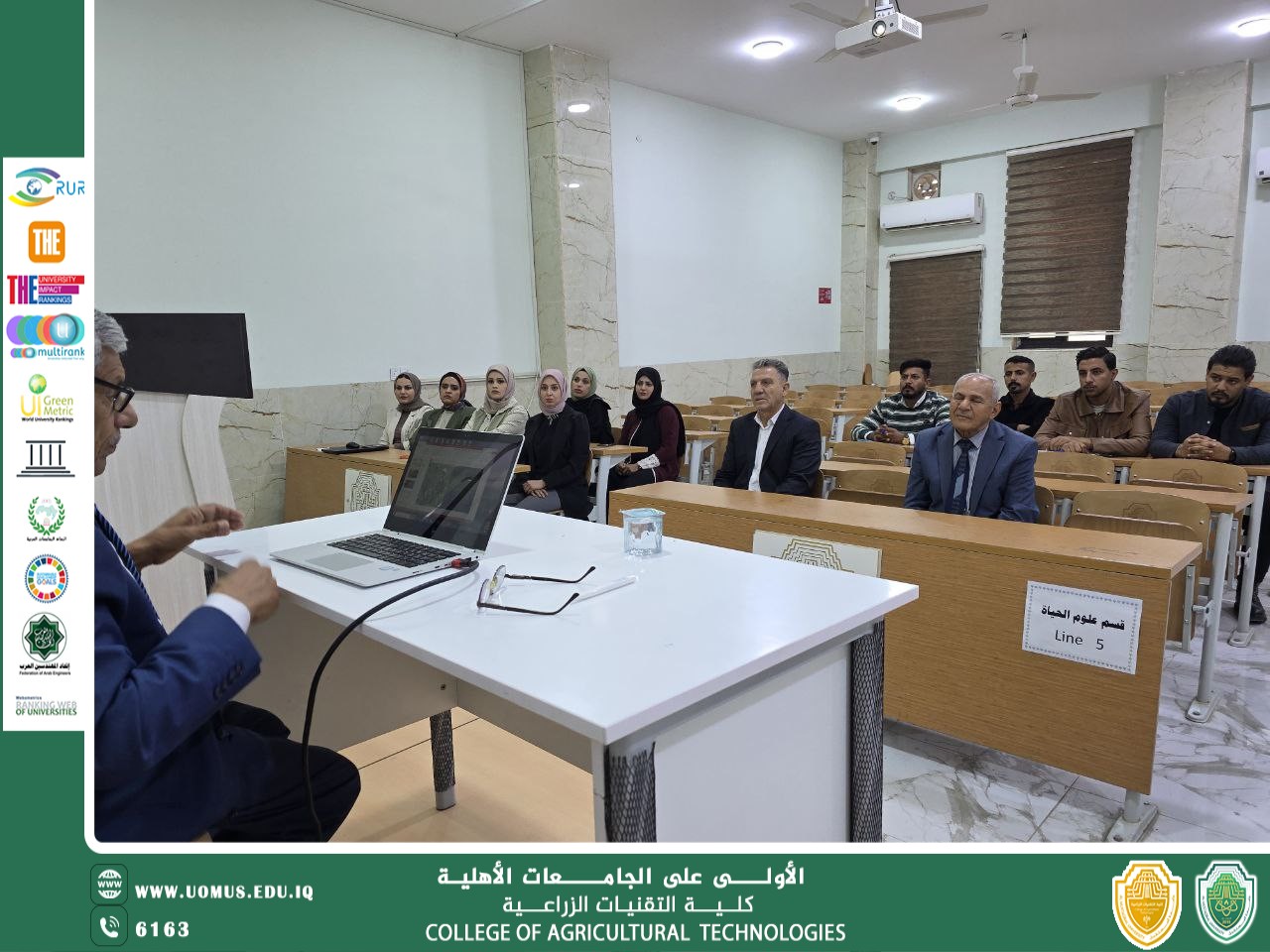

As part of the Future Week for Drug Prevention activities, a scientific seminar was held titled Agriculture and Drugs: Risks of Prohibited Crops.”
Under the esteemed patronage of Professor Dr. Hassan Shaker Majdi, President of the University,
and under the supervision of Professor Dr. Mahdi Abdul-Kadhim Abdul, Dean of the College of Agricultural Technologies,
the College organized, as part of the Future Week for Drug Prevention, a scientific seminar titled:
“Agriculture and Drugs: Risks of Prohibited Crops”
The seminar was delivered by Professor Dr. Majid Kazem Al-Hamzawi, Head of the Department of Medical Plant Technologies and Natural Products.
The seminar discussed the concept of narcotics as a global problem that causes significant human and economic losses due to their destructive psychological, social, and physical effects. Various narcotic plants and their classifications were reviewed in terms of active compounds, pharmaceutical and psychological effects, traditional uses, risk levels, and the plant parts involved.
The seminar also addressed the negative impacts of drug cultivation on agriculture and the environment, including the conversion of agricultural and economically valuable lands—as well as forests—into areas used for cultivating narcotic plants. It highlighted the resulting decline in biodiversity, destruction of natural habitats, spread of chemical pollution, increased cases of poisoning, and the rise in carbon emissions that contribute to global warming.
Under the esteemed patronage of Professor Dr. Hassan Shaker Majdi, President of the University,
and under the supervision of Professor Dr. Mahdi Abdul-Kadhim Abdul, Dean of the College of Agricultural Technologies,
the College organized, as part of the Future Week for Drug Prevention, a scientific seminar titled:
“Agriculture and Drugs: Risks of Prohibited Crops”
The seminar was delivered by Professor Dr. Majid Kazem Al-Hamzawi, Head of the Department of Medical Plant Technologies and Natural Products.
⸻
The seminar discussed the concept of narcotics as a global problem that causes significant human and economic losses due to their destructive psychological, social, and physical effects. Various narcotic plants and their classifications were reviewed in terms of active compounds, pharmaceutical and psychological effects, traditional uses, risk levels, and the plant parts involved.
The seminar also addressed the negative impacts of drug cultivation on agriculture and the environment, including the conversion of agricultural and economically valuable lands—as well as forests—into areas used for cultivating narcotic plants. It highlighted the resulting decline in biodiversity, destruction of natural habitats, spread of chemical pollution, increased cases of poisoning, and the rise in carbon emissions that contribute to global warming.