Prosthesis) Transtibial PTB Prosthesis (Below-Knee Conventional
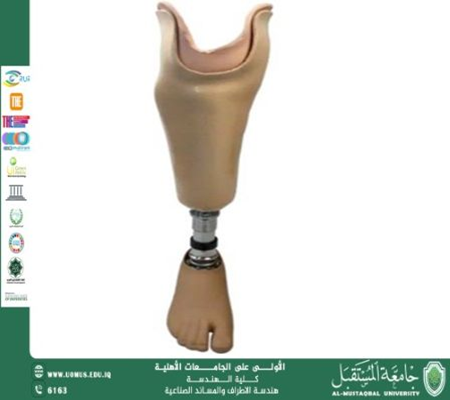
he Patellar Tendon Bearing (PTB) transtibial prosthesis is one of the most widely used traditional designs for below-knee amputation. Despite the emergence of more advanced models in recent years, this type remains common due to its simplicity, suitability for many cases, and its ability to provide adequate stability and functional performance—especially in early rehabilitation stages or for individuals with limited activity levels.
1. Socket
The socket is the most critical component of this prosthesis. Its design is based on distributing weight through pressure-tolerant areas such as the patellar tendon, medial tibial flare, and the posterior calf region, while relieving pressure from sensitive areas.
Key features of the PTB socket include:
A slightly elevated anterior brim to support the patellar tendon.
Specific contouring to relieve pressure at sensitive areas such as the tibial crest.
A soft inner liner (soft insert) to enhance comfort and minimize friction within the socket.
This design is particularly suitable for individuals who require precise pressure distribution, have sensitive skin, or possess relatively short residual limbs.
2. Suspension System
This prosthesis commonly uses simple suspension methods, such as:
Straps or elastic sleeves
SC/SCSP natural socket designs that provide suspension through supracondylar contouring around the femoral condyles
These systems provide good stability without the need for mechanical locks or valves, making them ideal for patients requiring low-complexity or low-maintenance solutions.
3. Pylon & Connectors
The prosthesis includes a lightweight metal pylon—usually aluminum or stainless steel—connecting the socket to the prosthetic foot.
The pylon typically features:
Multi-directional alignment adjusters
A simple shock absorption mechanism to reduce impact during walking
These components provide acceptable stability and flexibility while maintaining a simple structure.
4. Prosthetic Foot
This prosthesis usually incorporates the traditional SACH foot (Solid Ankle Cushioned Heel), which is characterized by:
A non-articulated ankle
A cushioned heel to absorb shock
Reliable support during standing and walking
Suitability for low- to moderate-activity users
Although it lacks the dynamic response and energy storage of modern carbon fiber feet, it remains a practical and economical choice.
5. Advantages
Simple design with easy maintenance
Good comfort due to soft inner liner
Acceptable stability during ambulation
Lower cost compared to advanced prosthetic systems
Suitable for newly rehabilitated amputees
Ideal for elderly individuals or those with limited activity levels
6. Limitations
Limited ankle movement due to absence of an ankle joint
Higher energy expenditure during gait compared to dynamic-response feet
Significant reliance on socket fit for comfort
Not suitable for high-activity or athletic users
Conclusion
The PTB below-knee prosthesis with a SACH foot represents a practical and reliable option for individuals who need a simple, stable, and cost-effective prosthesis—especially in early rehabilitation phases or among low-activity users. Despite major technological advancements in modern prosthetics, this traditional design remains a cornerstone solution due to its reliability, ease of use, and ability to meet the daily needs of most patients.