
The Butterfly Effect in Medical Physics: Between Biological Chaos and the Precision of Scientific Modeling Scientific Article by Instructor Zahraa Basim
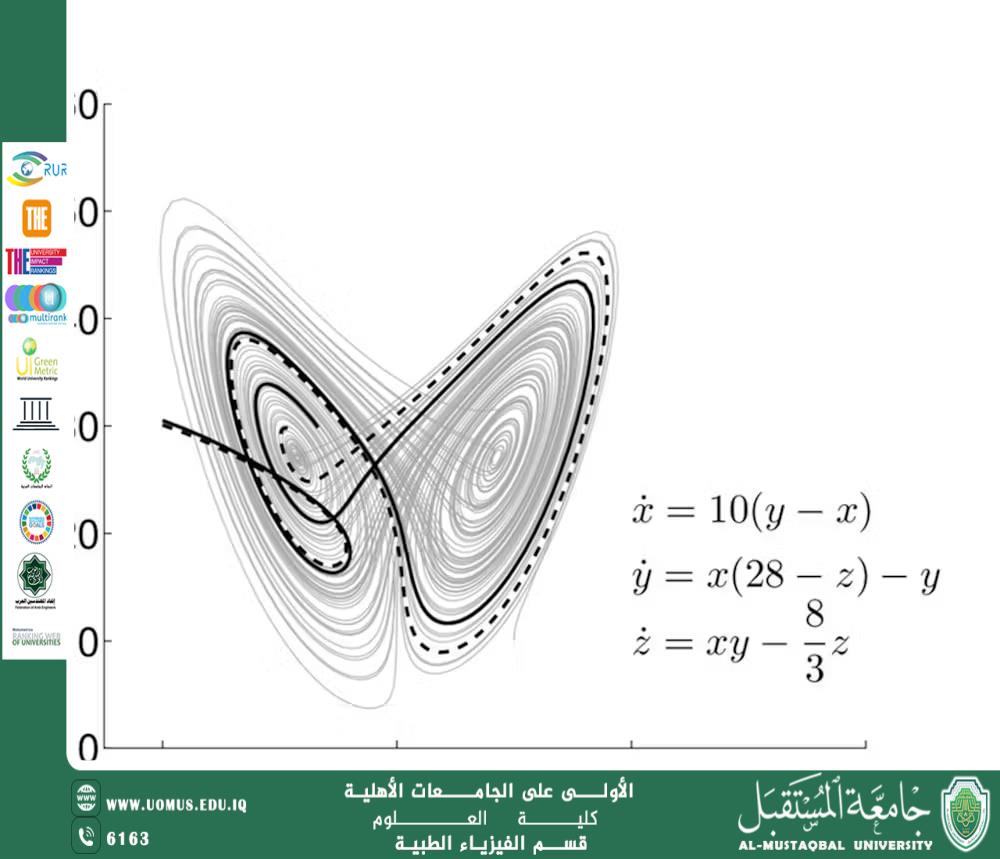
The Butterfly Effect is an extension of the concept of extreme sensitivity to initial conditions in non-linear systems, and it has become increasingly important in Medical Physics due to its role in understanding the complex behavior of biological devices and physiological processes.
For example, in hemodynamics (blood flow dynamics), a slight change in the vessel diameter or blood viscosity can lead to significant differences in pressure and flow velocity, directly impacting the diagnosis of cardiovascular diseases. In medical imaging—such as functional Magnetic Resonance Imaging (fMRI)—bio-signals show high sensitivity to small stimuli that may change the pattern of brain activity, necessitating precise mathematical models to interpret the data.
The Butterfly Effect also appears in the modeling of drug particle diffusion within the body, where a minor deviation in dosage or composition can alter the drug's kinetic pathway and therapeutic effect. Even in tumor physics, chaotic models are used to interpret changes in tumor growth in response to subtle changes in the cellular environment.
Thus, the Butterfly Effect assists researchers in Medical Physics in developing more accurate measurement tools and predictive models, and in understanding the biological complexity that governs contemporary medical systems.
AL_mustaqbal University is the first university in Iraq.