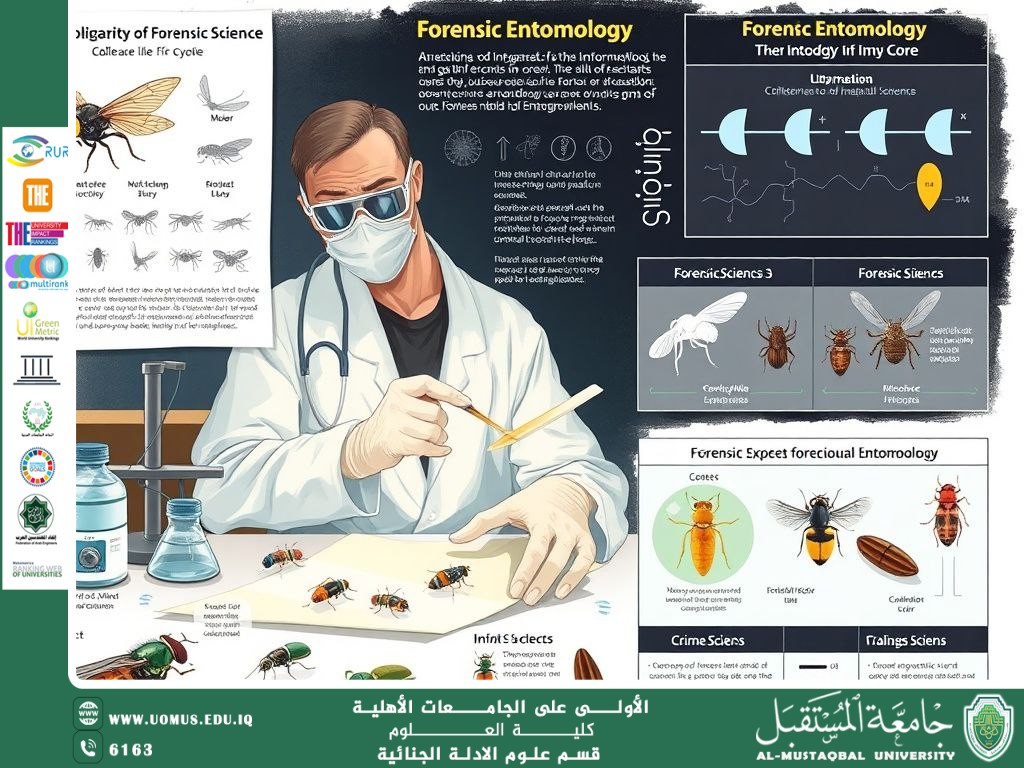

Integration Between Forensic Medicine and Forensic Entomology: An Applied Scientific Approach (M.M. Howayda Nazzal Hussein)
The integration of forensic medicine and forensic entomology represents a significant advancement in modern investigative science. By combining medical knowledge of postmortem physical changes with insect-based ecological and biological indicators, investigators gain a more comprehensive and accurate understanding of death circumstances and timelines.
1. Role of Forensic Medicine
Forensic medicine focuses on examining the physical and biochemical changes that occur in the human body after death, including:
Postmortem body temperature changes
Livor mortis and dehydration
Rigor mortis
Stages of decomposition
These indicators offer initial estimates of the postmortem interval (PMI), but they become less reliable as decomposition advances or when external environmental factors interfere.
2. Contribution of Forensic Entomology
Forensic entomology fills the gaps that traditional forensic medicine cannot address, especially in cases involving advanced decomposition. It provides additional tools such as:
Determining larval developmental age
Studying insect succession on the body
Reconstructing environmental conditions at the crime scene
Detecting toxins or drugs through larval analysis
These insights often reveal critical information about the time and circumstances of death.
3. Mechanisms of Integration
a. Joint Data Collection
Forensic pathologists and entomologists collaborate at the crime scene to document the condition of the body, environmental factors, and insect presence, ensuring a unified and accurate dataset.
b. Dual PMI EstimationThe pathologist provides PMI estimates using physiological postmortem markers, while the entomologist calculates PMI based on insect development. When combined, these approaches increase precision and reduce error margins.
c. Detecting Body Relocation
Differences between insect species found on the body and those typical of the discovery site may indicate postmortem relocation. This finding becomes stronger when supported by medical observations.
d. Strengthening Evidence in Court
Integrating entomological and medical evidence enhances scientific credibility and supports stronger conclusions in judicial proceedings.
Conclusion
The collaboration between forensic medicine and forensic entomology offers a robust scientific framework for modern criminal investigations. This applied approach bridges medical, biological, and environmental analyses, ultimately improving accuracy in determining time and circumstances of death and contributing significantly to uncovering the truth.
Al-Mustaqbal University – the first university in Iraq.
SDG4