Scientific Article for the Assistant Instructor (Madlula Moayed Faiq) Title: “Artificial Intelligence in Medicine”
إليك **الترجمة الإنجليزية الكاملة** للنص بشكل أكاديمي وواضح:
---
## **Artificial Intelligence in Medicine: A Scientific Revolution Transforming the Future of Healthcare**
### **Introduction**
In recent years, the world has witnessed rapid advancements in artificial intelligence (AI) technologies, which have become an essential part of many fields—most notably, medicine. AI has entered diagnostic systems, surgical procedures, and hospital management, making healthcare more accurate, faster, and more efficient.
### **First: What Is Artificial Intelligence in Medicine?**
Artificial intelligence is the ability of computers to analyze data, learn from it, and make decisions similar to human thinking.
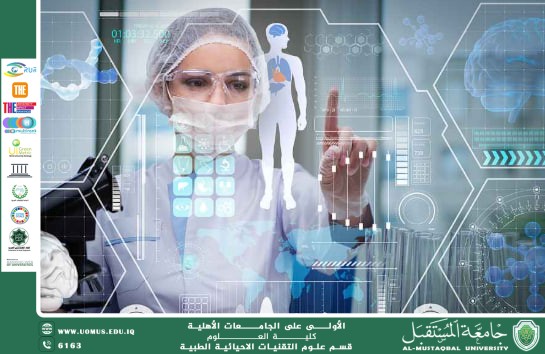
In medicine, AI is used to interpret medical images, evaluate laboratory tests, predict diseases, and monitor patients through advanced algorithms that continuously learn from medical data.
### **Second: Major Applications of Artificial Intelligence in the Medical Field**
#### **1. Early Disease Diagnosis**
AI can analyze medical images (such as ultrasound, CT scans, and MRI) with high accuracy.
It has helped detect cancer and cardiovascular diseases at early stages, increasing treatment success rates.
#### **2. Robotic Surgery**
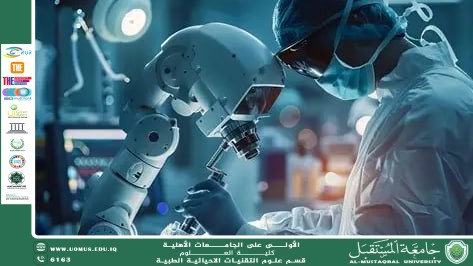
Surgical robots, such as “Da Vinci,” operate with AI assistance.
They offer exceptional precision and significantly reduce surgical errors.
#### **3. Big Health Data Analysis**
AI can process millions of medical records quickly.
It uses this data to predict epidemics or identify patterns that may not be obvious to physicians.
#### **4. Clinical Decision Support**
AI does not replace the physician, but it provides accurate insights that help them choose the most appropriate treatment—such as recommending medications that best suit the patient’s physiology.
#### **5. Remote Patient Monitoring**
Devices and applications capable of measuring blood pressure, glucose levels, and heart rate continuously monitor the patient and send real-time data to the physician.
### **Third: Benefits of Artificial Intelligence in Medicine**
* Reduced medical errors
* Faster diagnosis and treatment
* Lower healthcare costs
* Improved access to care in remote areas
* Saving physicians’ time and effort
### **Fourth: Challenges**
Despite its advantages, AI faces several obstacles:
* Lack of accurate medical data in some countries
* The need to protect patient privacy
* The importance of training healthcare workers to use new technologies
AI represents a major turning point in the history of medicine. Its goal is not to replace physicians, but to enhance their abilities with modern tools that make healthcare more accurate, faster, and more effective. As technology continues to advance, AI will undoubtedly become a fundamental part of hospitals and clinics worldwide.
**University of Al-Mustaqbal — The No.1 University in Iraq**