A scientific article by Lecturer M.M. Zahraa Jawad Kadhim entitled "The Role of Roots in Supporting Trees and the Dynamics of Water Absorption"
Roots are essential components of trees, providing vital functions that ensure their survival and health. They offer mechanical support, enabling the tree to stand firmly, and they absorb water and nutrients from the soil. The absorption process operates dynamically and depends on several internal and external factors.
1. Mechanical Support Provided by Roots
A. Anchoring the Tree
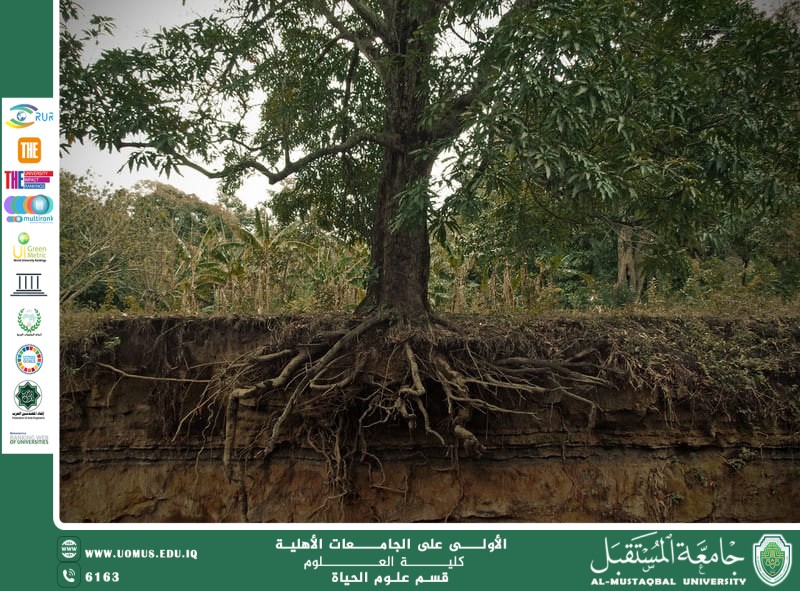
Roots extend horizontally and vertically through the soil, preventing the tree from falling.
They act as a natural network that stabilizes the soil and keeps the tree balanced during wind and storms.
B. Weight Distribution
The main roots bear most of the tree’s weight.
Lateral roots help stabilize the outer parts, especially in large trees.
C. Protection Against Erosion
In regions with heavy rainfall, roots prevent the tree from being washed away.
They also reduce soil erosion and protect against landslides.
2. Dynamics of Water Absorption
A. Absorption Through Root Hairs
The most active part in water absorption is the root hairs, which increase the surface area in contact with the soil.
Water enters the root hair cells through osmosis.
B. Water Movement Inside the Root
After absorption, water moves through:
The root cortex
The vascular cylinder
The xylem vessels, carrying it upward to the stem and leaves.
C. Role of Root Pressure
Roots generate internal pressure that pushes water upward, especially at night or in humid conditions.
This is known as Root Pressure.
D. Relation to Transpiration
Transpiration from leaves pulls water upward from the roots.
This creates a continuous water flow from the roots to the leaves.
E. Absorption of Minerals
Roots also absorb essential minerals such as nitrogen, phosphorus, and potassium.
Most mineral absorption occurs through active transport.
3. Factors Affecting Water Absorption
Soil type
Soil temperature
Moisture level
Tree age
Root length and spread
Al-Mustaqbal University is the first university in Iraq.