
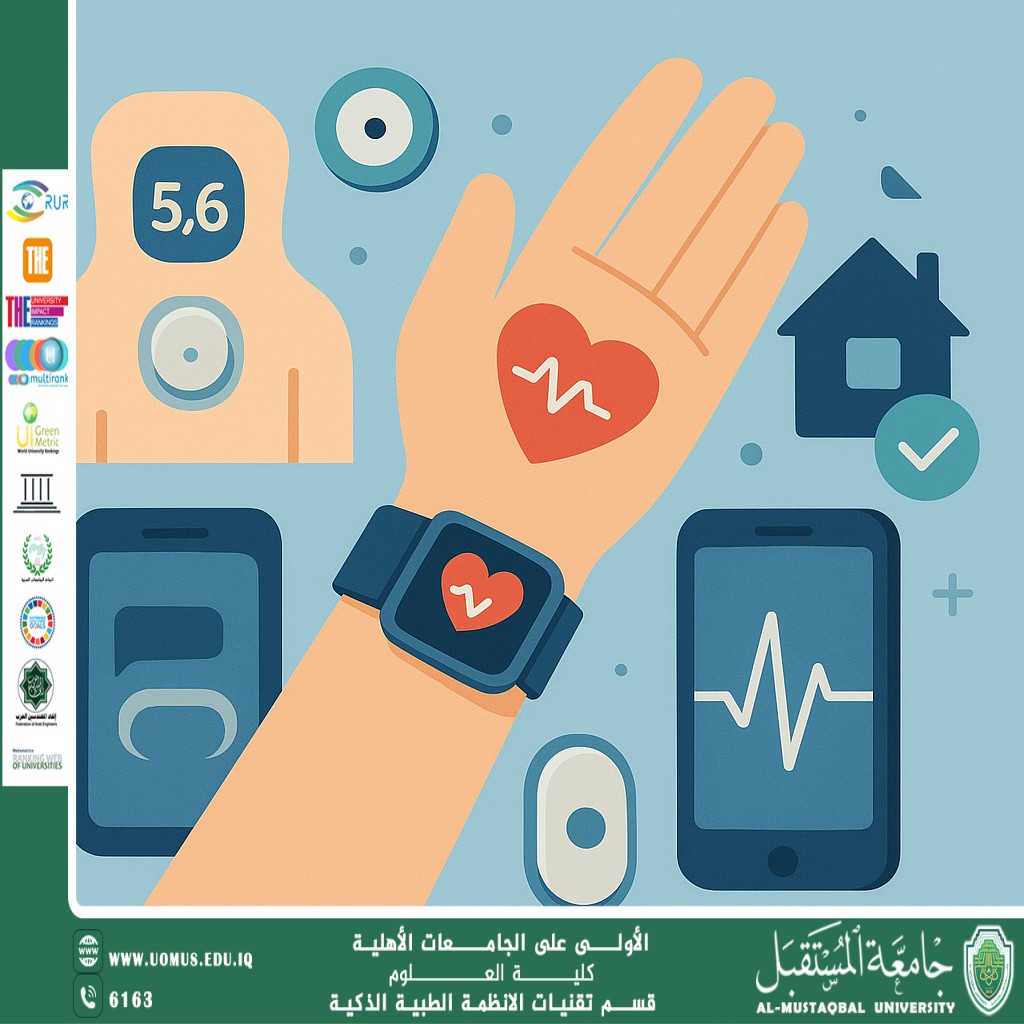
Wearable Medical Devices: Advanced Home-Based Care ( Prof. Dr. Mehdi Ebady Manaa)
In recent years, wearable medical devices have witnessed a remarkable surge in adoption within healthcare systems. These devices are no longer limited to counting steps or tracking physical activity; they have become an essential part of monitoring chronic diseases, observing critical conditions, and providing real-time data to physicians without the need for hospital visits. This shift represents an important evolution in the concept of healthcare, aligning with Sustainable Development Goal 3 (Good Health and Well-Being) by enabling continuous monitoring and prevention, and with Goal 11 (Sustainable Cities and Communities) by reducing pressure on hospitals and improving the quality of life for populations.
Wearable devices—such as medical smartwatches, heart rhythm trackers, respiratory sensors, and continuous glucose monitoring systems—work by collecting real-time physiological data from the patient’s body and sending it to a smartphone or a cloud-based medical platform. These data include heart rate, blood oxygen levels, deep sleep quality, and daily movement, in addition to advanced measurements such as ECG readings and alerts for atrial fibrillation, which is considered one of the most dangerous cardiac rhythm disorders.
These technologies are widely used among heart patients, individuals with diabetes, the elderly, and patients recently discharged from surgical procedures. For example, a physician can monitor a cardiac patient through immediate notifications triggered by sudden increases in heart rate, drops in oxygen levels, or abnormal electrical activity. Such continuous monitoring significantly reduces emergency cases and enables early intervention before severe complications occur.
In diabetes care, continuous glucose monitoring (CGM) devices represent a major medical breakthrough, providing patients with around-the-clock glucose readings and issuing alerts during dangerous spikes or drops. This helps patients manage their diet and medication intelligently and enables physicians to design precise treatment plans based on real data rather than estimations.
Beyond their clinical role, wearable medical devices offer great benefits at the public-health level. They help reduce unnecessary hospital visits, ease the burden on healthcare facilities, decrease overcrowding, and improve resource efficiency. They also support rural and remote communities, allowing patients to be monitored from a distance without traveling to major cities, thereby contributing to the development of more sustainable communities in accordance with Goal 11.
These devices also generate vast data sets that can be used in medical research to understand population-level health patterns, such as the prevalence of sleep disorders or the impact of physical activity on heart health. This supports efforts to enhance public-health policies and guide preventive programs, fulfilling one of the essential pillars of Goal 3, which focuses on strengthening preventive healthcare.
Wearable medical devices are not merely technological luxuries; they are a foundational pillar of the future of healthcare—a future built on prevention, continuous monitoring, and reliance on real-time data rather than guesswork, making healthcare more effective, humane, and sustainable.
Al-Mustaqbal University — The First University in Iraq.