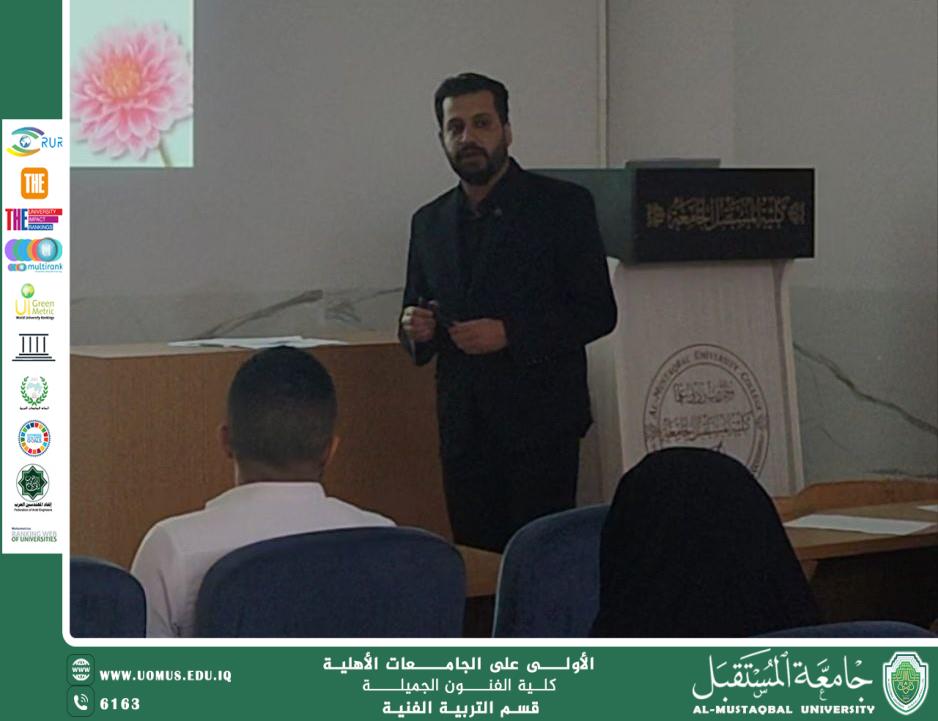

From Passion to Creativity: How Loving the Subject Leads to Successful Art Lectures – By Asst. Lecturer Hani Adhab
Teaching art goes beyond merely conveying academic information; it is an interactive process based on inspiration, experimentation, and sparking wonder in learners. Here, the teacher’s role emerges not just as a transmitter of knowledge, but as a catalyst for creativity and a creator of a vibrant learning environment. One of the key factors that drives this success is the teacher’s love for the subject they teach.
First: Loving the Subject Sparks Learners’ Curiosity
When a teacher speaks passionately about an artwork, the history of a particular art movement, or a new creative technique, this enthusiasm naturally transfers to the students. Learners feel that what they are hearing is not just mandatory content but a living experience worth engaging with. This passion increases attention, encourages questions, and promotes participation, making the lecture dynamic rather than routine.
Second: Passion Makes Knowledge Deep and Understandable
A teacher who loves their subject often puts in extra effort in research, exploration, and selecting suitable examples. They do not merely present superficial information but connect ideas with their artistic origins, techniques with their aesthetic impact, and theory with practice. This deep knowledge makes the content clearer and helps students build a solid foundational understanding of artistic creativity.
Third: An Inspiring Learning Environment Drives Creativity
Art requires a safe space for experimenting with ideas, proposing solutions, and expressing oneself freely. A teacher who loves their subject conveys this love through their teaching style, creating an environment that encourages experimentation without fear of mistakes. Consequently, students are more willing to discover their talents and develop their skills, understanding that creativity is a journey, not just a result.
Fourth: Loving the Subject Presents the Teacher as a Role Model
Students quickly sense the teacher’s sincerity. When they notice the teacher enjoying what they teach, they see them as a source of inspiration. The teacher’s influence extends beyond the classroom; they cultivate respect for art, enhance appreciation for beauty, and encourage students to see art as a space for reflection and change.
Conclusion
The success of art lectures is not solely tied to the curriculum but to the spirit in which it is delivered. When art is taught with passion, the lesson transforms into an experience, the teacher becomes an inspirer, and the students become creators. In this way, love for the subject serves as a bridge, guiding learners from mere understanding to expansive creativity.
Almustaqbal University, The First University in Iraq