
A Scientific Article Titled “Nanotechnology and Cancer” by (Taqa Adel Aboud)
“Nanotechnology and Cancer: The Shift from Traditional Therapy to Precise Targeting”
Introduction
Cancer is considered one of the most complex and challenging health problems of our time. Despite the major advancements in traditional treatments such as surgical removal, chemotherapy, and radiotherapy, these methods are often associated with side effects, as they tend to damage both healthy and cancerous cells without distinction.
Here, nanotechnology emerges as a new hope and a promising solution. It deals with extremely small materials and measurement units ranging from 1–100 nm, offering highly precise tools capable of overcoming the limitations of current treatments.
How Nanoparticles Differ from Traditional Cancer Treatments
Scientists utilize nanotechnology in research due to the major differences it offers compared to conventional treatment approaches. Some of the most important advantages include:
1. Targeted Drug Delivery
Drugs can be loaded into nanoparticles, which are engineered to contain receptors that match those on the surface of cancer cells.
This offers an alternative to injecting chemotherapy throughout the entire body.
Advantages:
Nanoparticles travel directly to the tumor, significantly reducing the concentration of the drug in healthy tissues.
2. Precise Early Diagnosis
Nanoparticles can be used as enhanced contrast agents in medical imaging techniques such as MRI, due to their small size and controllable physical and chemical properties.
They can easily penetrate cells and tissues, enabling earlier and more accurate detection of tumors.
3. Photothermal Therapy
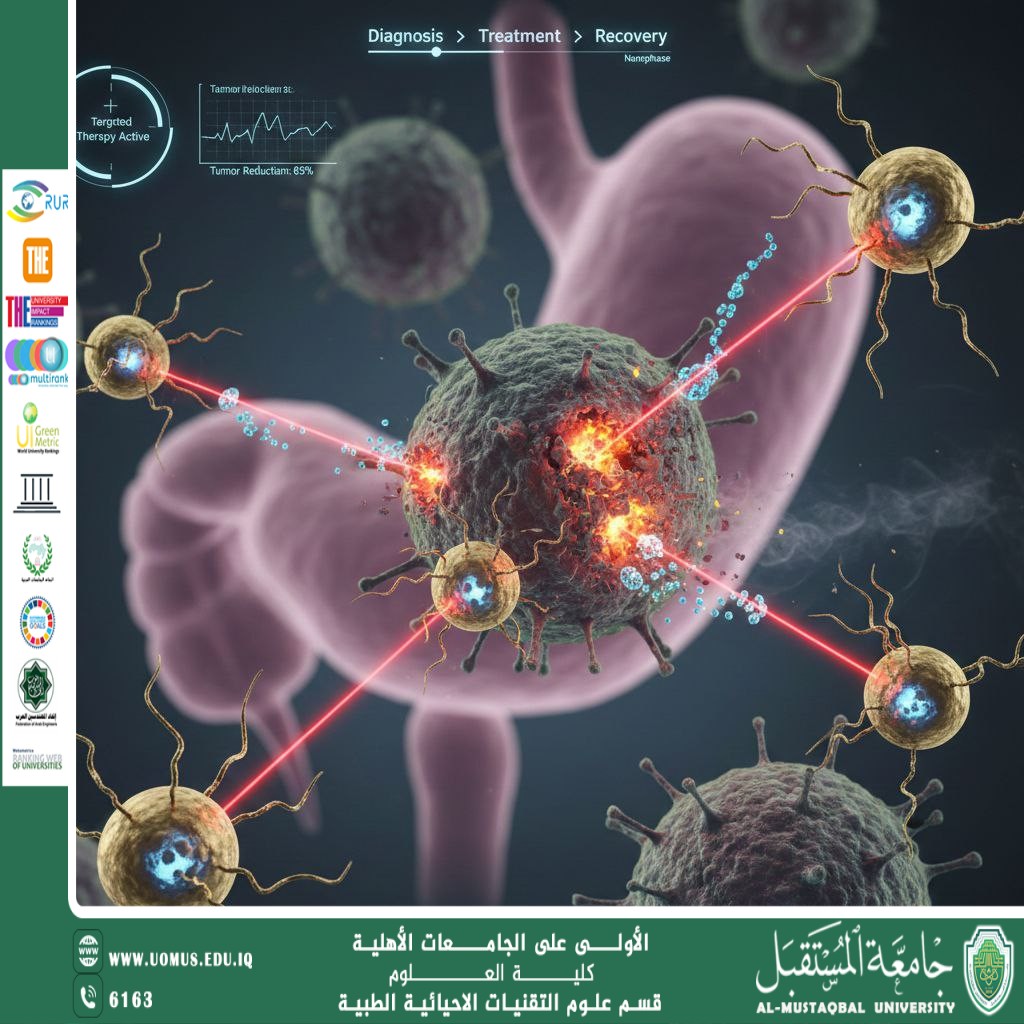
This advanced treatment involves injecting nanoparticles—such as gold nanoparticles—into the tumor. These particles absorb external laser light and convert it into concentrated heat capable of destroying surrounding cancer cells, while leaving healthy tissues unharmed.
Future Applications Under Study
Numerous nano-based materials and products have been developed, including:
1. Liposomes
These are nanoscale lipid spheres used to carry well-known chemotherapeutic drugs such as Doxorubicin directly to cancer cells.
2. Nanosensors
These sensors help detect cancer-related proteins in the blood, assisting in monitoring disease recurrence.
Future Prospects
Nanotechnology represents a bridge toward complete healing.
Studies confirm that nanotechnology is not just another conventional tool—rather, it is a transformational advance in the future of cancer therapy.
Future directions include:
A full transition toward targeted therapy, ensuring destruction of the tumor only, instead of indiscriminate damage to both healthy and cancerous cells.
Offering solutions for complex tumors that are difficult to remove surgically or resistant to traditional treatment.
Developing rapid or at-home nano-based diagnostic tests for early cancer detection, greatly increasing the chances of successful treatment.
Conclusion
Nanotechnology is a powerful and promising tool for the future of cancer treatment. With its remarkable ability to achieve precise targeting and deliver therapy without harming healthy cells, nanotechnology offers more effective and less painful treatment options.
As research continues, this highly advanced technology heralds a new era in which cancer may shift from a deadly threat to a chronic, fully treatable condition.
References
This article was written based on recent and reliable scientific reviews, particularly research focusing on the applications of nanoparticles in cancer therapy and diagnosis.
Source: https://www.researchgate.net/publication/356793629_Nanoparticles_for_Cancer_Therapy_Current_Progress_and_Challenges
Al-Mustaqbal University — The First University in Iraq