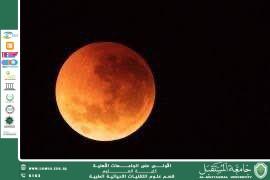

A scientific article entitled "Lunar Eclipse" (Heba Salah Hadi).
Types of Lunar Eclipses:
1. Total Eclipses:
This occurs when the Moon is completely within the Earth's umbra (shadow), causing its light to disappear entirely, and its color to turn a deep red or coppery—a phenomenon known as a "blood moon."
2. Partial Eclipses:
In this type, only a portion of the Moon enters the Earth's umbra, making it appear partially obscured or "eaten."
3. Penumbral (Light) Eclipses:
This occurs when the Moon passes through the Earth's penumbra (the area of the Earth's shadow). The Moon appears dimly lit, and this type is often difficult to observe with the naked eye.
⸻
How Do Lunar Eclipses Occur?
During the Earth's orbit around the Sun, the Moon orbits the Earth at a slight angle (about 5 degrees), making a complete alignment of the Sun, Earth, and Moon rare. When this alignment occurs, the Earth blocks sunlight from reaching the Moon, resulting in a lunar eclipse.
⸻
The Difference Between Lunar and Solar Eclipses:
• Lunar Eclipse: Occurs at night when the Earth is positioned between the Sun and the Moon.
• Solar Eclipse: Occurs during the day when the Moon is positioned between the Earth and the Sun, and the Moon completely or partially covers the Sun's disk.
⸻
The Importance of Lunar Eclipses:
Although lunar eclipses pose no danger to Earth or humans, they hold significant scientific and cultural importance. Scientists use them to study Earth's atmosphere and observe the Moon's movements. They were also used in ancient times for calculating calendars and timekeeping.
Al-Mustaqbal University, the leading university in Iraq.