The Role of Artificial Intelligence in Medicine
Abstract
Artificial Intelligence (AI) has become a transformative force in modern medicine. It enhances healthcare quality, accelerates diagnosis, and supports medical decision-making. This article discusses the role of AI in medicine, its applications, benefits, and associated challenges.
Introduction
Artificial Intelligence is a branch of computer science focused on developing systems capable of simulating human intelligence. In recent years, AI has gained significant importance in medicine due to the increasing volume of medical data and the complexity of healthcare systems.
Applications of AI in Medicine
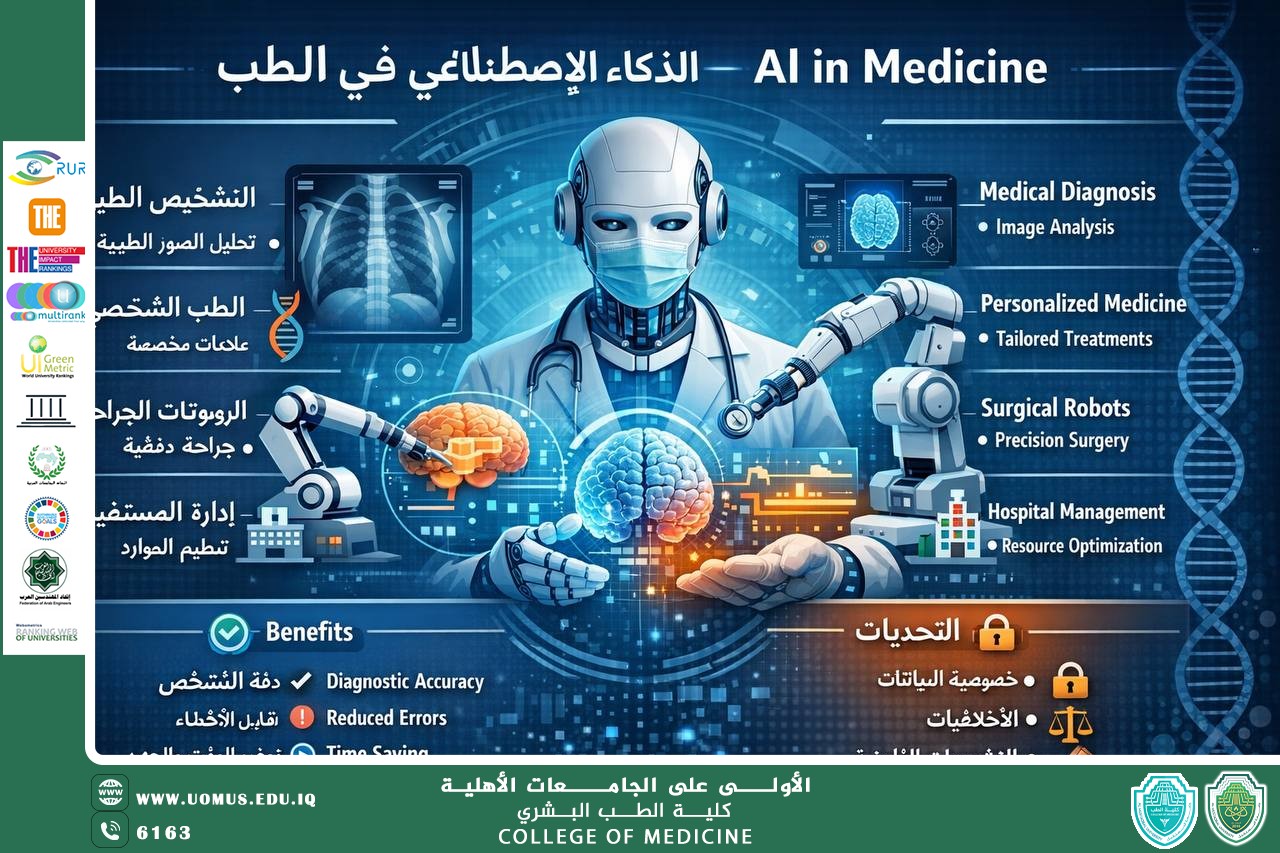
Medical Diagnosis: Deep learning algorithms analyze medical images such as X-rays and MRI scans, enabling early and accurate disease detection.
Personalized Medicine: AI helps create customized treatment plans based on a patient’s genetic and medical data.
Surgical Robots: AI-powered robots assist surgeons in performing precise procedures with fewer errors.
Hospital Management: AI systems optimize scheduling, resource management, and patient flow.
Benefits of AI in Medicine
Improved diagnostic accuracy
Reduced medical errors
Time and cost efficiency
Enhanced healthcare quality
Challenges
Despite its advantages, AI faces challenges such as data privacy concerns, ethical issues, and the need for clear legal regulations.
Conclusion
AI represents the future of modern medicine. With responsible implementation and continuous development, it can significantly improve healthcare outcomes.
Al-Mustaqbal University ranks first among private universities.