A Scientific Article: The UV-Vis Spectrophotometer and Its Applications in Chemical and Biological Analysis By Instructor: M.M. Haidar Mutlaq Musa
Introduction
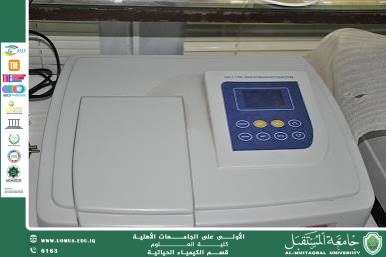
The Ultraviolet-Visible(UV-Vis) Spectrophotometer is one of the most essential instruments in chemical and biological laboratories. This device measures the amount of light absorbed by a substance at specific wavelengths, allowing for precise estimation of concentration and analysis of chemical and physical properties.
Principle of Operation
The device operates based on the Beer-Lambert Law,which relates absorbance (A) to the concentration of the substance (C), the path length (L), and the molar absorptivity (ε):
A = \varepsilon \cdot C \cdot L
When light passes through a sample, molecules absorb a portion of it. The higher the concentration, the greater the absorbance.
Components of the Device
A UV-Vis spectrophotometer consists of several key components:
1. Light Source
· Ultraviolet light: Deuterium lamp
· Visible light: Tungsten-Halogen lamp
2. Monochromator
Selects a specific wavelength by dispersing white light into individual wavelengths using:
· A prism
· A diffraction grating
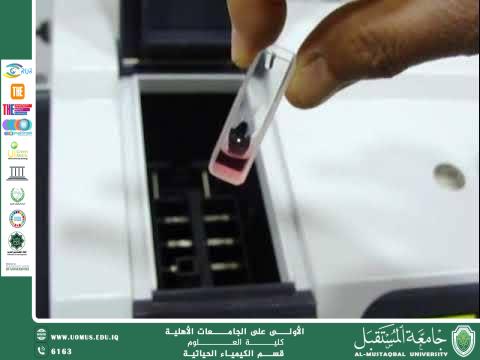
3. Sample Compartment
Holds the cuvette, which may be:
· Plastic (for visible light)
· Glass
· Quartz (for ultraviolet light)
4. Detector
· Photodiode
· Photomultiplier tube
Converts the light signal into an electrical signal measured as absorbance.
5. Reading and Processing System
A screen or computer software to display spectra and perform calculations.
Types of Measurements in UV-Vis
· Absorbance Measurement: For determining concentrations using a standard curve.
· Transmittance Measurement: The ratio of light transmitted through the sample.
· Spectral Scanning: To obtain a substance's spectrum and identify its maximum absorption wavelength (λ_max).
Applications in Biochemistry
1. Protein Measurement
· Serum proteins at 280 nm or using dyes such as:
· Bradford
· Lowry
· BCA
2. Nucleic Acid Measurement (DNA, RNA)
· At 260 nm to determine purity and concentration.
3. Enzyme Measurement
· By monitoring reaction rates and changes in absorbance over time.
4. Measurement of Biological Factors in Blood
· Zinc
· Magnesium
· Iron
· Copper
Using colorimetric methods.
Examples of Device Usage
· Zinc (Zn) Measurement: Using the reagent 5-Br-PAPS, which forms a colored complex measured at 560 nm.
· Magnesium (Mg) Measurement: Using Xylidyl Blue reagent, measured at 520 nm.
Analysis of the Standard Curve
A series of standard solutions with known concentrations are prepared.Absorbance is measured and plotted against concentration to create a calibration curve, which is then used to determine the concentration of unknown samples.
Advantages
· High speed and accuracy.
· Good sensitivity.
· Requires very small sample volumes.
· Suitable for routine and research analyses.
Disadvantages
· Highly affected by sample purity.
· Requires good calibration.
· Cannot distinguish between substances with similar spectra.
Conclusion
The UV-Vis spectrophotometer is a vital and fundamental tool in biochemistry and clinical analysis.Its precision in measuring absorbance, ease of use, and versatility make it the primary instrument in research and clinical laboratories, particularly for measuring essential elements, enzymes, and proteins.
--
University of Al-Mustaqbal Ranks First Among Iraqi Private Universities