Laser induced fluorescence (LIF)
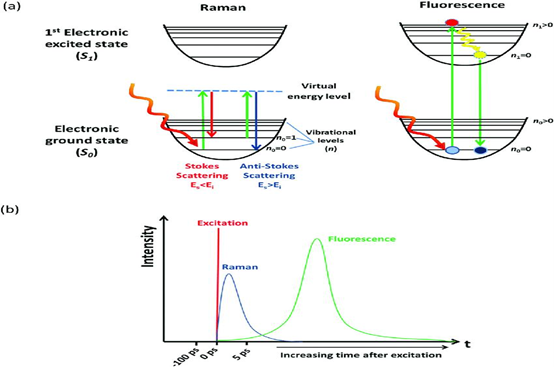
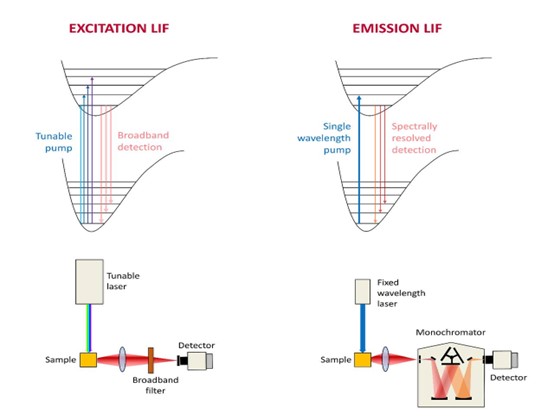
Every material has its own characteristic electromagnetic absorption and emission spectrum. Atoms or molecules that are excited to high energy levels can decay to lower levels by emitting radiation (emission or luminescence). Laser-induced fluorescence (LIF) is a molecular emission spectroscopic technique based in the absorption of light emitted by a laser. Molecules that absorb laser light enter into excited electronic states and eventually return to the ground electronic state via radiative means (i.e. by emission of light); they are said to “fluoresce”. Fluorescence is effectively the opposite of absorption .The LIF spectrum of a substrate (surface of an object or sample) provides information directly related to the molecular structure of materials on the illuminated substrate. The species that are responsible of fluorescence emission can be, i.e. the molecules in a molecular substrate, or some impurities or crystal defects into solids. Most solid substances have broad absorption bands in the UV region and a pulsed UV laser is frequently most useful for inducing fluorescence. In LIF the use of a laser as excitation source offers the advantage of selective excitation using specific light wavelengths within the absorption spectrum of a particular species allowing the identification of materials with high certainty. Together with this versatility, laser sources offer also the possibility of high-resolution measurements useful for the detection of small traces of substances or chemical compounds. Thus LIF is a versatile, selective and accurate technique that aims at the identification of the emitting own constituents of the material of the illuminated substrate.LIF emission takes place in a short interval after the initial light absorption event (that happens very fast, in around 10-15 s). The total time spent in the excited electronic state(s) is known as the ‘fluorescence lifetime’ which is usually of the order of few ns (10-9 s) to μs (10-6 s). Fluorescence spectroscopy alone not always provides an exhaustive identification of a sample, as the emission spectra are generally characterized by broad peaks. Yet, temporal characteristics (fluorescence lifetime measurements), together with the intensity of the emission and its spectral features, supply information that can assist in the discrimination and identification of compounds.<br />The figure shows Representation of Raman and fluorescence phenomena upon laser excitation of a molecule, and (b) schematics of the timescale of Raman and fluorescence processes. <br /> The figure 2 shows Schematic representation of excitation (left) and emission (right) Laser Induced Fluorescence spectroscopy. <br /><br />By: MSc. Hawraa Abd Alkareem