Al-Mustaqbal Energy Research Center Launches a Specialized Engineering Series on Solar PV System Design Episode One: PV String Sizing in Hot Climate Conditions – Iraq Case Study
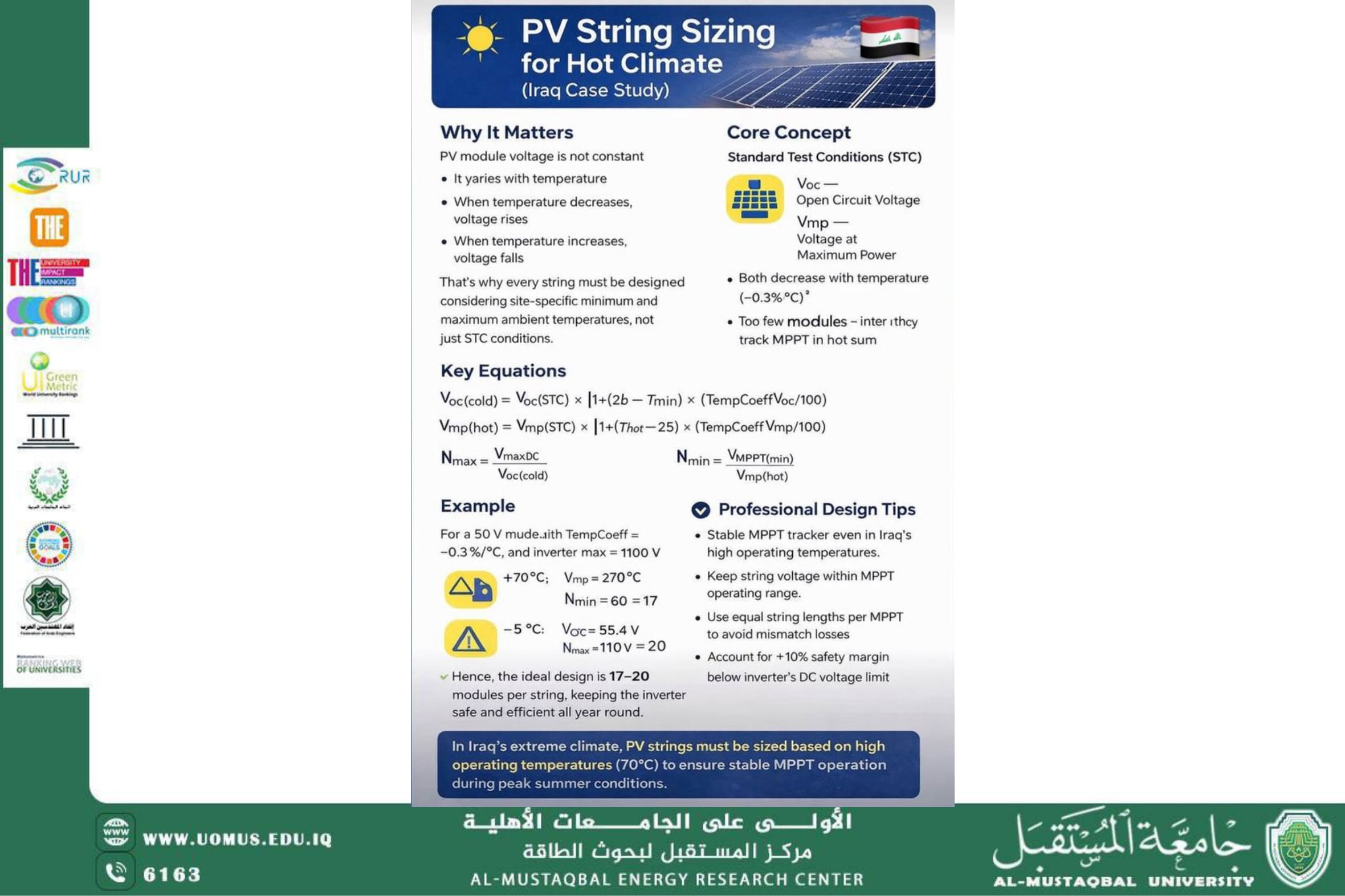
Al-Mustaqbal Energy Research Center has launched a specialized engineering series focusing on best practices in solar PV system design, aiming to improve system safety, efficiency, and reliability under Iraq’s harsh climatic conditions. The first episode addresses one of the most critical aspects of PV electrical design: PV String Sizing, due to its direct impact on inverter protection, MPPT stability, and annual energy yield. ⸻ Why PV String Sizing Is Critical in Iraq PV module voltage is temperature-dependent: • Voltage decreases at high temperatures, common during Iraqi summers, • Voltage increases at low temperatures, which may occur during winter. Improper string sizing may cause inverter overvoltage in winter or MPPT voltage mismatch in summer, leading to reduced energy production or system shutdowns. ⸻ Key Equations Used in PV String Sizing Open-Circuit Voltage at Minimum Temperature V_{oc(cold)} = V_{oc(STC)} \times \left[1 + (25 - T_{min}) \times \frac{TempCoeff_{Voc}}{100}\right] This equation is used to determine the maximum number of modules per string: N_{max} = \frac{V_{DC(max,\ inverter)}}{V_{oc(cold)}} ⸻ Maximum Power Voltage at High Operating Temperature V_{mp(hot)} = V_{mp(STC)} \times \left[1 + (T_{hot} - 25) \times \frac{TempCoeff_{Vmp}}{100}\right] This equation determines the minimum number of modules per string: N_{min} = \frac{V_{MPPT(min)}}{V_{mp(hot)}} ⸻ Iraq-Based Design Example Assuming: • V_{oc(STC)} = 50 V • V_{mp(STC)} = 41 V • Temperature coefficient = −0.3 %/°C • Inverter DC max = 1100 V • MPPT minimum voltage = 600 V • T_{min} = -5°C • T_{hot} = 70°C Results: • N_{max} \approx 20 modules • N_{min} \approx 17 modules Recommended design: 17–20 modules per string
Images Attachments