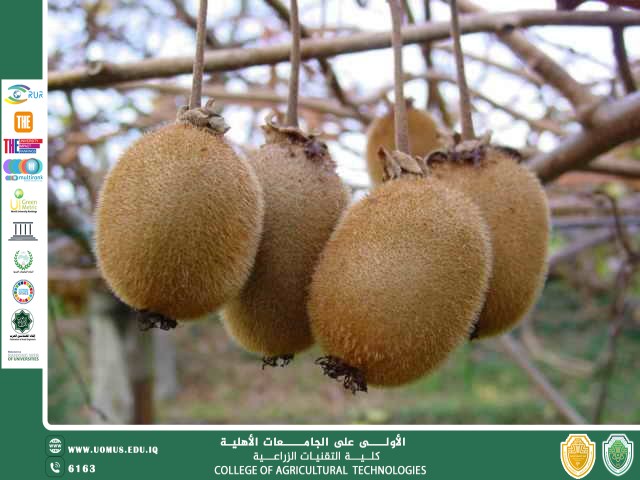
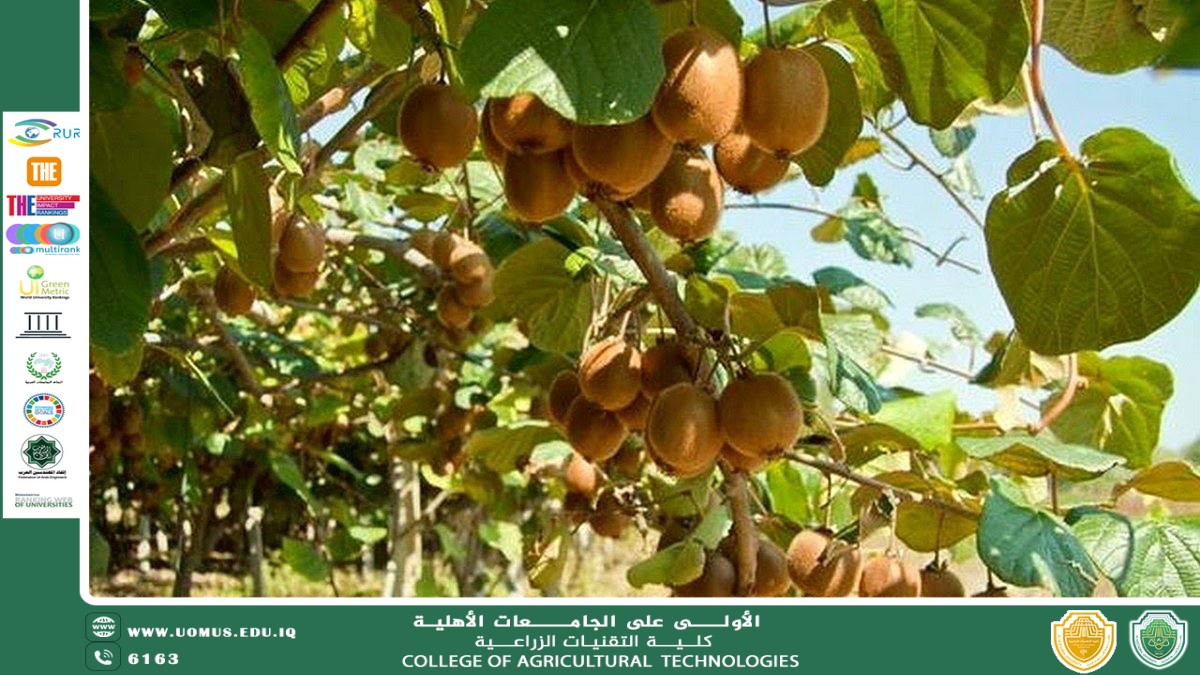
Kiwi
14/01/2026 Share :
Kiwi
Prof. Dr. Tahani Mohammed Jawad Ali
Scientific Name: Actinidia deliciosa
Family: Actinidiaceae
Kiwi is a deciduous plant native to China. It has a relatively high acidity level, reaching up to 2% of the fresh weight in some cultivars, and it is an excellent source of vitamin C.
Kiwi belongs to the climbing plants (vines) and therefore requires supports and trellising systems, similar to grapevines, for proper growth.
⸻
Suitable Environment
1. Kiwi plants require 600–1000 chilling hours, while some cultivars need only 100–300 chilling hours.
2. The plant requires a frost-free environment, especially protection from spring frosts. A temperature drop below –1°C for 30 minutes is sufficient to damage young shoots and small fruits. In some regions, overhead sprinklers are used to protect plants from frost damage.
3. Kiwi requires a moderate summer climate, with temperatures not exceeding 35°C.
4. During winter dormancy, the plant can tolerate temperatures as low as –12°C in some cultivars, while other cultivars can withstand temperatures down to –40°C.
5. The plant does not tolerate heavy soils with poor aeration or soils with a high groundwater level.
6. Kiwi prefers light soils rich in organic matter, with low levels of calcium carbonate and chloride salts.
7. The plant grows best in soils with a pH of around 6; increasing the pH to 7.2 leads to general ضعف in plant growth.
⸻
Flowering and Fruiting Characteristics
1. Kiwi is a dioecious plant (similar to date palm), meaning male and female flowers are borne on separate plants. Therefore, male plants must be planted in the orchard at a ratio of 1 male : 10 female plants.
2. Some cultivars are self-fertile, bearing both male and female flowers on the same plant.
3. Flower buds are borne laterally on one-year-old shoots, in addition to lateral fruiting on spurs.
4. Pollination occurs through insects and wind (mixed pollination).
Al-Mustaqbal University is ranked first among private universities in Iraq.