
Awareness Seminar Entitled: Rationalizing Water Consumption: A National and Ethical Responsibility
20/01/2026 Share :
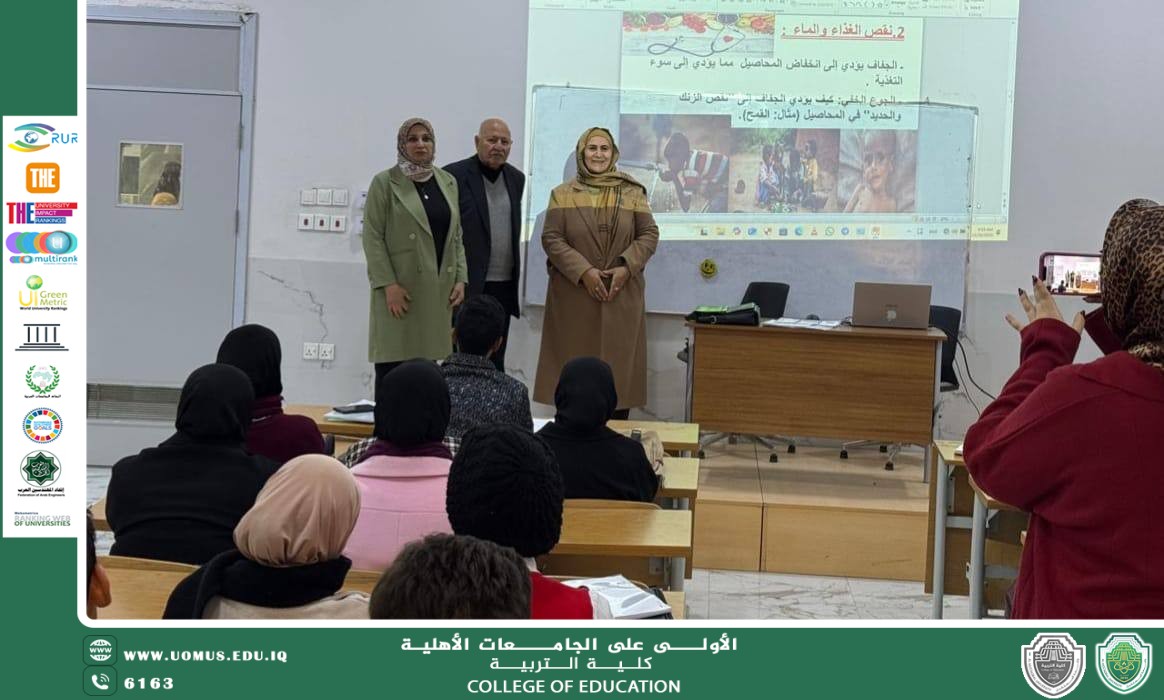
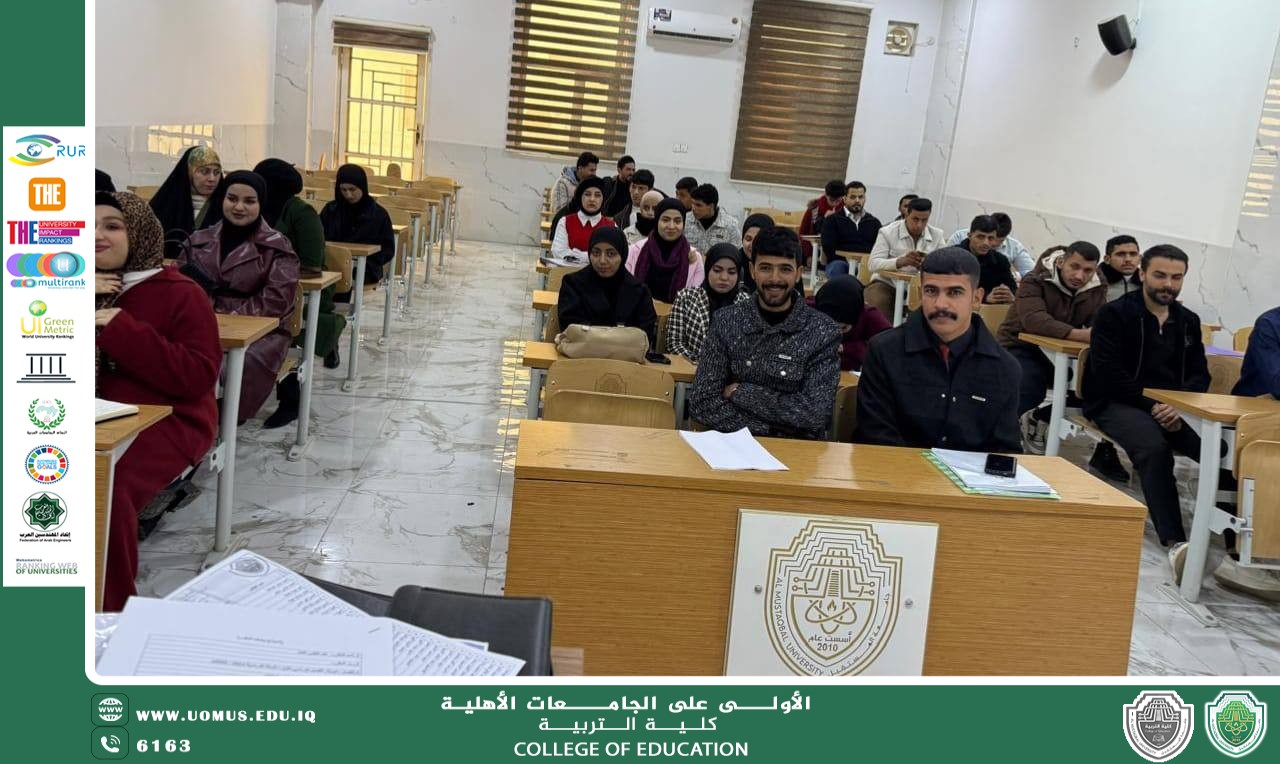
Under the patronage and personal attendance of the Assistant Professor Dr. Ahmed Rodhan Salman, Dean of the College of Education, the College of Education / Women’s Affairs Unit organized an awareness seminar entitled “Rationalizing Water Consumption: A National and Ethical Responsibility”, targeting first-year students of the Department of Educational and Psychological Sciences.
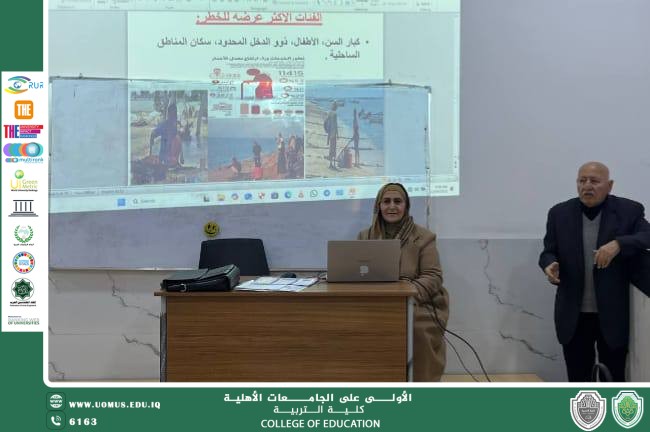
The seminar was delivered by Professor Dr. Thanaa Baha’a Al-Din Abdullah, Head of the Women’s Affairs Unit at the College, with the participation of Assistant Lecturer Mari Imran Mahdi, Head of the Women’s Affairs Division at the University, and Assistant Lecturer Jaafar Sadiq Al-Zuhairi. The seminar was held on Tuesday, 30/12/2025, at 9:00 a.m., in Hall 108, Humanities Building.
The seminar addressed the concept of rationalizing water consumption and discussed the current state of water resources globally and in the Arab world in general, and in Iraq in particular. It highlighted the reasons for water conservation from several perspectives. From the religious perspective, it emphasized the prohibition of extravagance in water usage even during acts of worship, citing the saying of the Prophet Muhammad (peace be upon him): “Do not waste water, even if you are on the bank of a flowing river.” From the economic perspective, the seminar discussed the high cost of water desalination and purification, and the importance of preserving water resources for future generations. From the environmental perspective, it focused on maintaining ecological balance and reducing the energy consumed in desalination processes.
The seminar also shed light on the use of modern irrigation systems, such as drip irrigation and sprinkler irrigation, selecting crops suitable for the climate, and farming at appropriate times to reduce evaporation. In addition, it addressed methods of water conservation in the public and industrial sectors, including reusing treated water for irrigation and industry, developing cooling systems in factories, and regularly maintaining water networks.
Furthermore, the seminar discussed practical initiatives and measures, including governmental initiatives through public awareness programs, supporting the installation of water-saving devices, and adopting water pricing policies that encourage conservation. It also highlighted community initiatives carried out by schools and universities, civil society organizations, and the role of social media in spreading environmental awareness. Some global success stories in water conservation were presented, such as the Singaporean experience in water reuse.
The seminar emphasized the role of each individual as a responsible citizen, through self-monitoring of water consumption, teaching children the value of water, and reporting leaks in public places. The seminar concluded with a set of recommendations, including adopting water conservation as a societal culture, integrating conservation concepts into educational curricula, and providing incentives to citizens and sectors that achieve water savings.
In conclusion, the seminar affirmed that water is life, and that rationalizing its consumption is not an option but an existential necessity, calling on students to be ambassadors of conservation, to start with themselves, and to teach their children that every drop of water has value. As the poet said: “The lessons of the early generations may benefit, as the young learn from their actions what should be avoided.”
#College_of_Education
#Al_Mustaqbal_University