
Promoting Decent Work and Economic Growth through Effective Partnerships to Achieve the Sustainable Development Goals
18/01/2026 Share :
Prof. Dr. Haider Ali Al-Dulaimi
College of Administrative Sciences
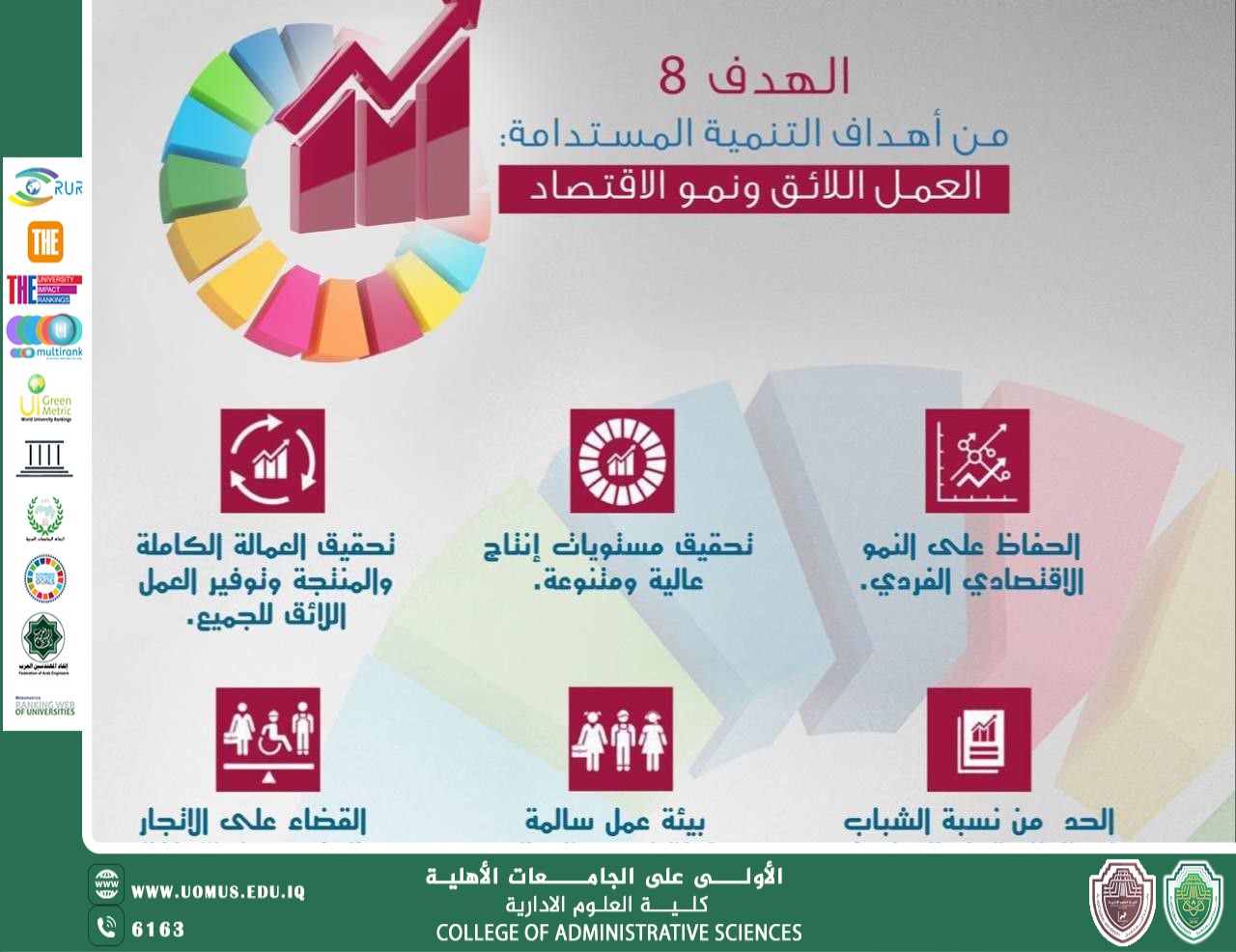
Amid the rapid economic and social transformations taking place worldwide, issues of decent work and sustainable economic growth have become among the most prominent challenges facing countries and institutions alike. This is underscored by Sustainable Development Goal 8, which seeks to promote sustained, inclusive, and sustainable economic growth, as well as full and productive employment and decent work for all. However, achieving this goal cannot be realized in isolation from cooperation and integration, highlighting the importance of Goal 17, which focuses on building effective partnerships to achieve the Sustainable Development Goals.
Decent Work and Economic Growth: A Development Priority
Decent work represents a cornerstone in building stable and productive societies, as it ensures fair income, social protection, safe working conditions, and equal opportunities without discrimination. Sustainable economic growth also contributes to improving living standards, reducing poverty, and promoting social justice. Accordingly, investing in human capital, developing skills, and supporting innovation and entrepreneurship are among the fundamental requirements for achieving this goal.
Effective Partnerships as a Pathway to Achieving the Goals
Governments alone cannot bear the responsibility of achieving decent work and economic growth. Rather, this requires integrated partnerships that include the private sector, academic institutions, civil society organizations, and international organizations. Such partnerships contribute to exchanging expertise, mobilizing resources, and coordinating efforts, thereby ensuring the implementation of more efficient and sustainable policies and programs.
The private sector plays a pivotal role in job creation and innovation support, while academic institutions contribute to preparing qualified human capital and aligning educational outcomes with labor market needs. Civil society organizations also play an important role in raising awareness, advocating for workers’ rights, and supporting the most vulnerable groups.
The Role of Educational Institutions and Universities
Colleges and universities are key partners in achieving Goals 8 and 17 through developing academic programs that keep pace with sustainable development requirements, encouraging applied scientific research, and building partnerships with productive sectors. Training activities and community service initiatives further contribute to equipping students and graduates with the skills required for the labor market, while fostering a culture of decent work and social responsibility.
Toward Sustainable Development Based on Cooperation
Promoting decent work and economic growth can only be achieved through a comprehensive vision based on cooperation and partnership among all stakeholders. The integration of Goal 8 with Goal 17 provides a clear model of how challenges can be transformed into opportunities and how a more inclusive and sustainable economy can be built—one that serves the present and safeguards the rights of future generations.
Within this framework, the role of educational institutions, including our College and University (Al-Mustaqbal University), emerges in supporting these efforts through knowledge, research, and the building of effective partnerships, thereby contributing to the achievement of the Sustainable Development Goals and the promotion of comprehensive national development.