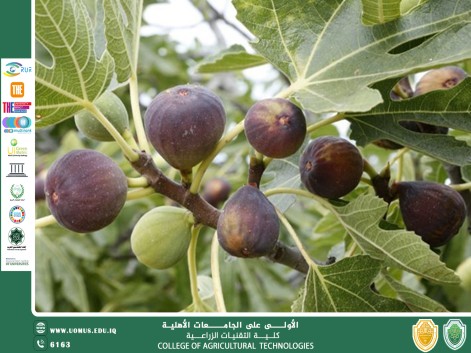
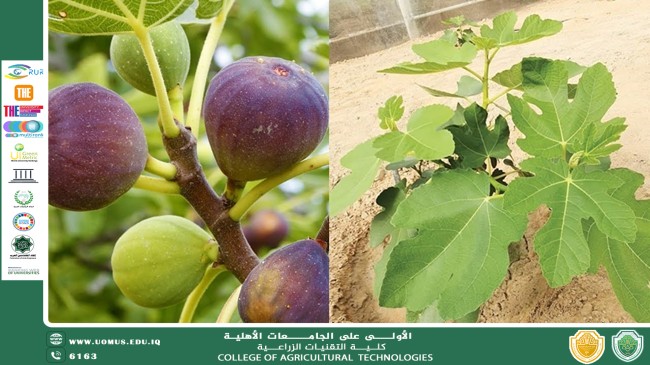

Figs
24/02/2026 Share :
Fig
Prof. Dr. Tahani Mohammed Jawad Ali
Scientific name: Ficus carica
Family: Moraceae (Mulberry family)
⸻
Origin
The original homeland of fig is believed to be the southern Arabian Peninsula.
⸻
Tree Characteristics
• Deciduous trees with a relatively short trunk.
• Leaves are large, thick, and pubescent (hairy) on both upper and lower surfaces, with prominent veins.
• Buds are located in the leaf axils. Usually, two buds are found at the shoot tips:
• One vegetative bud
• One mixed (flower) bud
• The mixed bud may develop laterally on the previous year’s growth to produce the first crop, or on the current season’s growth to produce the second (main) crop.
⸻
Suitable Environmental Conditions
1. Very low chilling requirements; trees are highly sensitive to low temperatures.
2. Mature trees may die if temperatures drop to −6°C to −9°C in early winter.
3. High fruit quality is obtained when the average summer temperature is about 30°C. Temperatures above 40°C reduce fruit quality, making them dry with a leathery texture.
4. High humidity near ripening causes fruit cracking, leading to microbial infection and fruit fermentation.
5. Fig trees tolerate heavy, poorly aerated soils, relatively high groundwater levels, and alkaline soils.
⸻
Flowers
• Flower buds are borne laterally on one-year-old shoots or on current season growth.
• The inflorescence (syconium) is a fleshy, swollen, hollow receptacle containing numerous small flowers inside.
• At the top of the cavity, there is a small opening called the “eye,” covered with scales.
There are two types of figs based on flower composition:
• Caprifig (wild fig): Contains both male and female flowers inside the cavity.
• Common edible figs: Contain only female flowers.
⸻
Types of Fig Flowers
There are three types of fig flowers:
1. Short-styled female flowers
• Ovary swollen, style short.
• Adapted to host the eggs of the fig wasp (Blastophaga).
• Known as gall flowers.
2. Long-styled female flowers
• Ovary oval-shaped, style long.
• Not adapted to host the fig wasp.
3. Male flowers
• Ovary rudimentary; produce pollen.
Female flowers occupy most of the syconium cavity, while male flowers are located near the eye opening.
Gall flowers occur in caprifigs, whereas long-styled female flowers are present in most edible fig cultivars.
Types of Figs
1. Caprifig Trees (produce three crops):
• Mamme
• Profichi
• Mammoni
Caprifigs are commercially grown mainly for the second crop (Profichi), which is used to pollinate non-parthenocarpic fig varieties.
The process of transferring pollen from the Profichi crop of caprifigs to receptive female flowers of other varieties is called Caprification.
2. Smyrna-type Figs
3. San Pedro Figs
4. Common Figs
• The first crop (Breba) is produced parthenocarpically.
• In some cultivars, parthenocarpic fruits are produced only in certain years.
• Some cultivars may fail to produce fruit in some seasons (e.g., White Adriatic).
Fruit Set and Development
Fruit growth begins after fruit set, either parthenocarpically or following pollination.
The growth curve resembles that of stone fruits, with two growth stages separated by a period of relative dormancy.
This dormancy is due to low internal auxin levels. Spraying with auxins promotes rapid fruit growth and shortens the dormancy period.
⸻
Multiple Cropping in Common Fig (Very Important)
Some cultivars may produce fruit throughout the year under suitable climatic conditions, while in other regions they produce one or two crops.
1. Breba (Hawa crop)
• Fruits borne laterally on previous year’s growth.
• Buds develop in early spring.
• Fruits ripen in early summer.
2. Main crop (Summer crop)
• Fruits borne laterally on current season’s growth.
• Buds develop in late spring.
• Fruits ripen in late summer.
3. Late crop (Suhailli)
• Extension of the second crop.
• Borne on secondary shoots.
• Ripens in late autumn.
• Fig trees do not require thinning of flowers or fruits.
• They do not exhibit alternate bearing.
• Planting distance: 5–7 meters.
⸻
Irrigation
• Fig trees tolerate limited irrigation due to their relatively shallow root system.
• Severe water deficiency causes small fruit size, weak growth, leaf shrinkage, and leaf drop.
• Excessive irrigation leads to fruit cracking, fermentation, and increased susceptibility to diseases and pests.
Al-Mustaqbal University is ranked first among private universities in Iraq.