Scientific article by Lecturer Hamza Nader entitled: “Excimer Laser in Ophthalmology"
02/03/2026 Share :
Introduction
The excimer laser is one of the most important modern technologies in the field of ophthalmology, especially in correcting refractive errors such as myopia, hyperopia, and astigmatism. This laser has revolutionized vision correction surgeries, enabling millions of patients to forgo eyeglasses and contact lenses.
What is an Excimer Laser?
The excimer laser is an ultraviolet laser that typically operates at a wavelength of 193 nanometers (ArF). It is distinguished by its ability to remove corneal tissue with high micron-level precision without causing thermal damage to surrounding tissues, through a process called photoablation.
How the Excimer Laser Works
The excimer laser works by:
1. Breaking the molecular bonds in the corneal tissue.
2. Reshaping the corneal surface with high precision. 3. Changing the eye's refractive power to improve image focusing on the retina.
This high precision makes the results predictable and safe when the appropriate patient is selected.
Uses of the Excimer Laser in Ophthalmology
1️⃣ Correction of Myopia (Nearsightedness)
The cornea is reshaped to reduce its refractive power.
2️⃣ Correction of Hyperopia (Farsightedness)
The cornea is reshaped to increase its refractive power.
3️⃣ Correction of Astigmatism
The irregularity of the corneal surface is corrected.
Major Procedures Using the Excimer Laser
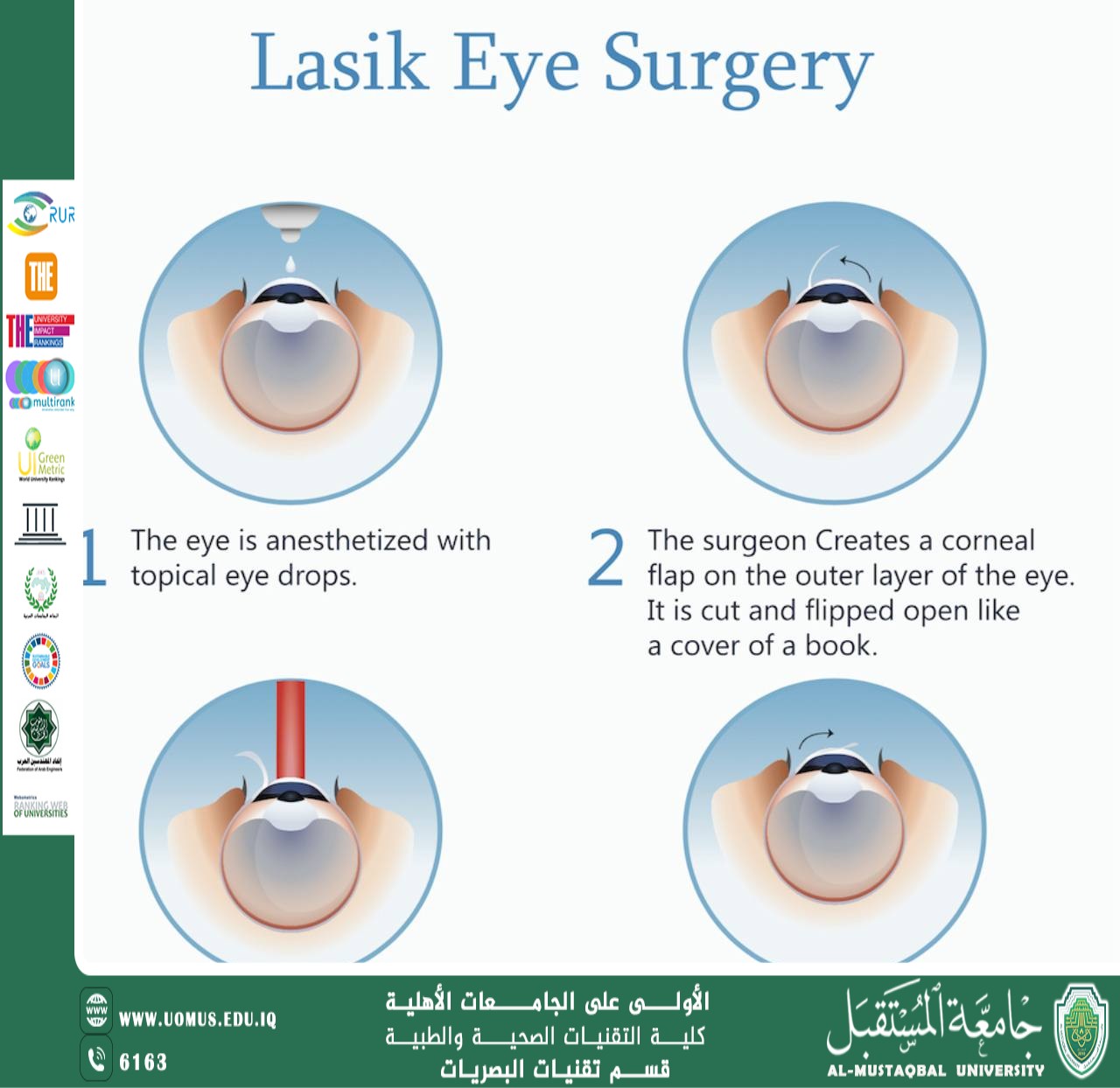
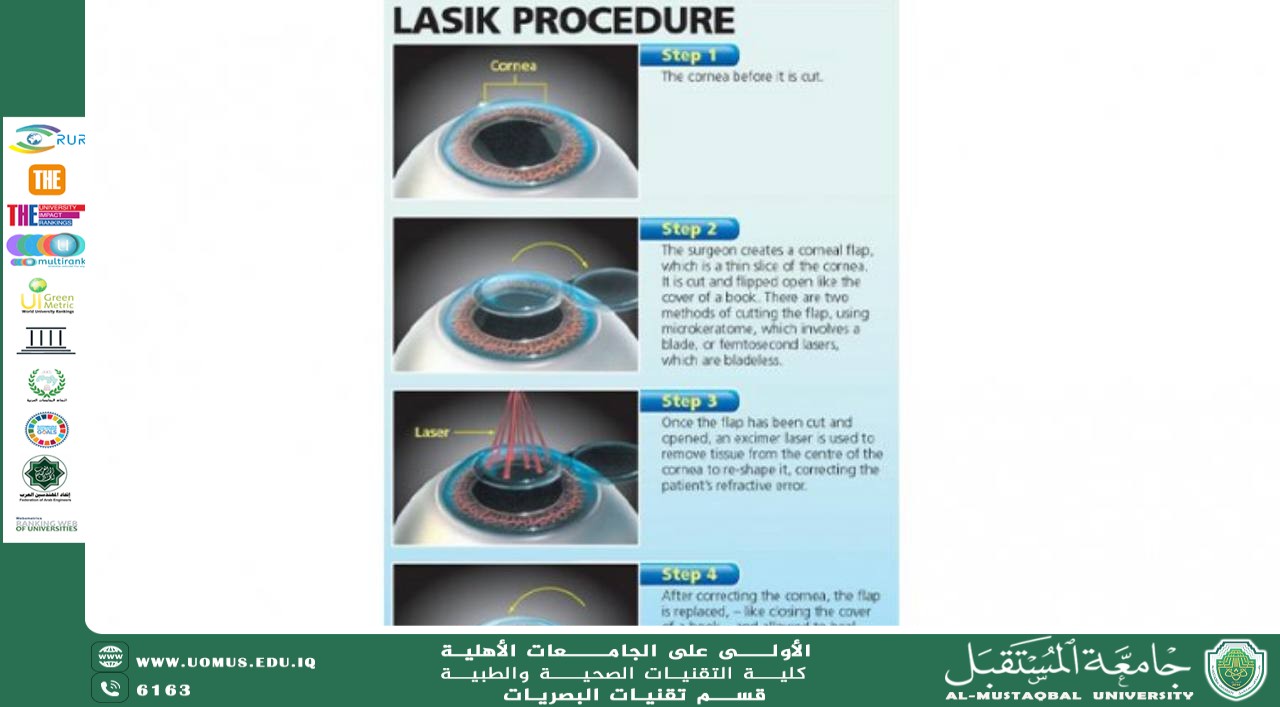
• LASIK
A thin flap is created in the cornea, and the laser is used to reshape it.
• PRK
The corneal flap is removed, and the laser is applied directly.
• LASEK
An intermediate technique between LASIK and PRK.
Advantages of Excimer Laser
• Very high precision (micron precision).
• Minimal thermal damage.
• Rapid results and noticeable vision improvement within days.
• High safety profile when medical standards are followed.
Potential Complications
Despite its high safety profile, some complications may occur, such as:
• Temporary dry eye.
• Glare or halos at night.
• Under- or over-correction.
• Rarely: Poor corneal healing.
Criteria for Patient Selection
• Age over 18 years.
• Stable vision for at least one year.
• Sufficient corneal thickness.
• Absence of corneal diseases such as keratoconus.
Recent Advancements
Advanced techniques have emerged, such as:
• Wavefront-guided LASIK
• Topography-guided LASIK
These techniques rely on precise corneal maps to improve visual acuity and reduce visual aberrations.
Conclusion
The excimer laser is considered one of the greatest achievements in modern ophthalmology, providing an effective and safe solution for correcting refractive errors. With continuous advancements in corneal tracking and imaging systems, the results have become increasingly accurate and safe.
University of Al-Mustaqbal – The First and Leading Private University