
Clinical Importance in the Diagnosis of Pleural Effusion Prepared by: Assist. Lect. Abbas Hamza Khudhair Department of Biochemistry – College of Science – Al-Mustaqbal University
08/03/2026 Share :
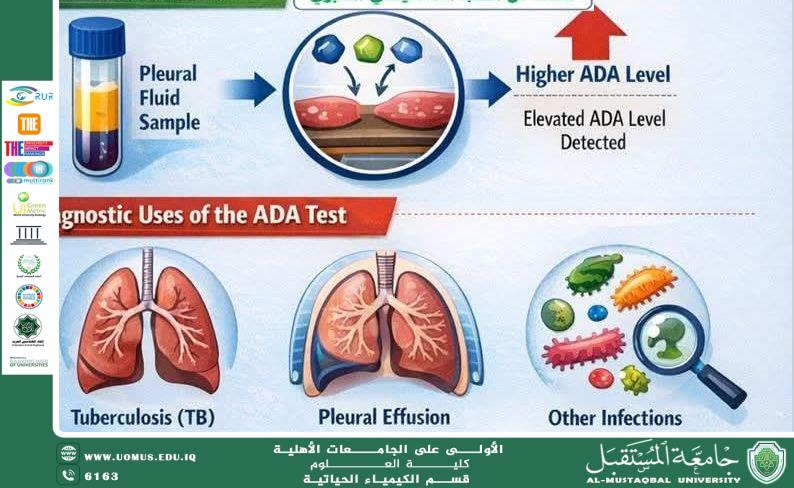
The Adenosine Deaminase (ADA) test is a laboratory investigation used to measure the activity of the enzyme adenosine deaminase in body fluids, particularly pleural fluid. ADA plays an essential role in purine metabolism and is closely linked to lymphocyte proliferation and activation, especially during cell-mediated immune responses.
Biological Principle
ADA is an enzyme involved in the deamination of adenosine to inosine. Its activity increases in conditions characterized by enhanced T-lymphocyte activation. Therefore, elevated ADA levels reflect strong cellular immune responses, particularly in infectious diseases such as tuberculosis.
Major Clinical Applications
Supportive diagnosis of tuberculous pleural effusion (TPE)
Differentiation between exudative and transudative pleural effusions
Evaluation of inflammatory pleural conditions
Elevated levels may also be seen in empyema, certain bacterial infections, and lymphoma
A pleural fluid ADA value greater than 40 U/L is generally considered strongly suggestive of tuberculosis, depending on clinical and epidemiological context.
Conclusion
The ADA test is a valuable and cost-effective diagnostic tool in the evaluation of pleural effusion, particularly when tuberculosis is suspected. However, results must always be interpreted alongside clinical findings and confirmatory investigations such as AFB smear, PCR for Mycobacterium tuberculosis, and culture.
Al-Mustaqbal University – Ranked First Among Iraqi Private Universities