(Deconstruction)
24/02/2025 Share :
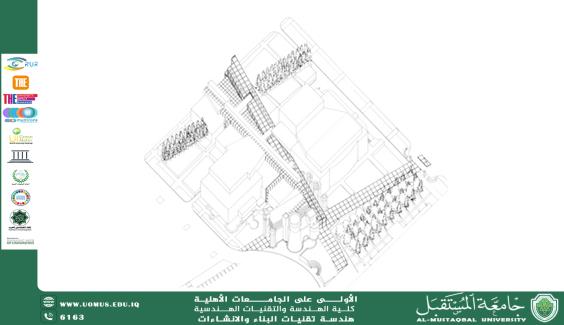
By Dr. Sabah Mohammad<br /><br />It emphasizes:<br />- Reducing the dominance of the author's presence and giving a role to the viewer or reader.<br />- Deconstructing systems and liberating from constraints and dominant concepts of thinking.<br />- Breaking academic boundaries between texts and different fields.<br />- Emphasizing difference, absence, traces, multiplicity, and contrast as the basis for meaning.<br /><br />Peter Eisenman sees the displacement of traditional binaries as hierarchical classifications, proposing a state where there is no dominant side to explore the "between" within these classifications.<br /><br />Experimental — Rational <br /> The "Between"<br /><br />- The loss of the concept of a strong architectural form (which implies presence), in favor of a weak image that removes the concepts of containment and presence, overcoming human domination over nature, and emphasizing absence, indeterminacy, and arbitrariness.<br />- Denial of the idea of space and internal containment.<br /><br />Deconstruction and the Element of Surprise:<br /><br />Charles Jencks, the thinker, says that Deconstruction is architecture of breaking, asymmetry, and incoherence. It's architecture filled with unexpected surprises that use classical architectural elements in an inverted or distorted way (Manda Magazine, 2007).<br /><br />There are key directions in Deconstruction Architecture:<br />- Deconstruction and Connection: Calls for deconstructing the whole into parts and reassembling them in a non-traditional manner.<br /> <br />Modern Construction Movement, led by Zaha Hadid:<br />- In Zaha's work, there is no distinction between forming the shape and its representation.<br />- It is freed from the constraints of traditional function and representation.<br />- Focused on dynamic forms free from gravitational forces.<br />- One of her programmatic and metaphysical foundations is confusion and disruption.<br />- Her works feature excessive abstraction in curving lines, projections, and slanted roofs.<br /><br />Foolishness Trends.<br /><br />Nihilism, led by Peter Eisenman: Characterized by extreme abstraction (Arabic Magazine Forum, 2007). Eisenman was concerned with the loss of the center and its formal transformations, his concept of the presence of the absent, and the appearance of explosive spaces and drawings (Al-Khafaf, 1996). Thus, Deconstruction architecture surprised us with what it brought.<br /><br />Eisenman set the characteristics that architecture in our current age should embody:<br />- Difference, formal transformations, and decentralization.<br />- His ideas attack the concepts of occupation, functionality, and human scale, among other traditional ideas. He doesn't care for self-expression, but rather the loss of self.<br />- He believes the discovery of "in-between" architecture comes within binary classifications such as: construction/decor, shape/function, formation/abstraction. These are hierarchical classifications where one is original, and the other is derivative, with form following function. Value has been given to both, with construction seen as good and decoration as bad. In this way, through rhetorical shapes, deconstruction can reveal what was written. <br /><br />The image represents the campus of Ohio State University in the 19th century around the first building, the university hall. It kept its distance from the city of Columbus by creating a campus grid displaced from the city's grid by twelve and a quarter degrees. As the campus grew, this grid was rationalized and expanded from the central campus oval, reinforcing the separation of the university from its urban context.<br /><br />Project: The Kartal Pendik Master Plan <br />- Project Area: 5.55 km² <br />- Location: Istanbul, Turkey <br />- Designer: Zaha Hadid <br />- Award-winning project for the redesign of an abandoned industrial site (new sub-center) in Istanbul. The site is a convergence of several important infrastructures, including: a coastal highway, a marine bus station, and a railway station connecting to the metropolitan area. This urban fabric is interconnected through a planning system of buildings that respond to the needs of different neighborhoods in the study area.