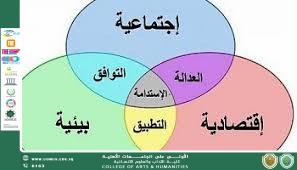
{The dean of the college writes a scientific article titled "The Economic Dimension of Sustainable Development."
25/02/2025 Share :
The economic dimension of sustainable development focuses on achieving sustainable economic development, creating job opportunities, and fostering economic prosperity. It aims to promote inclusive and equitable economic growth and includes improving infrastructure, enhancing sustainable and innovative industries, encouraging investment in clean technology, and improving financial and institutional management. This means that sustainable economic development is concerned with changing patterns of production and consumption and considers the lifestyle of people. The economic dimension of sustainable development can be observed in light of the following agreements:<br /><br />1. Stopping the waste of natural resources: Natural resources are an important part of wealth and cannot be accounted for or treated as a free resource. Sustainable development in industrial countries seeks to conserve energy and wasted natural resources by improving material management efficiency. This can be either on the surface of the earth used in agriculture, industry, tourism, and transportation, which includes waste and by-products, or underground, which contains various energy mineral resources such as coal, oil, uranium, and water resources like rivers, seas, lakes, and oceans, along with their aquatic life. Additionally, it includes the air and the atmosphere surrounding the earth and the gases contained within this atmosphere.<br /><br />2. Modifying consumption patterns to achieve greater sustainability: Sustainable development is concerned with continuously modifying and achieving sustainable consumption of energy and natural resources. Excessive consumption of resources by humans without planning leads to a conflict between the share of the current generation and the future generations.<br />Al mustaqbal University , the number one university in Iraq.<br />