
An Article "The School of Athens: Raphael's Genius and the Sustainability of Artistic Thought " By: Assistant Professor Dr. Ali Atiya Al-Saadi
27/06/2025 Share :
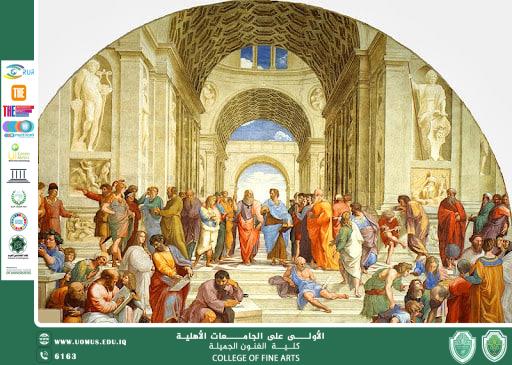
The School of Athens, painted by Italian maestro Raphael Sanzio between 1509 and 1510, adorns the Apostolic Palace in the Vatican and stands as a pinnacle of High Renaissance art.<br />The painting assembles iconic Greek philosophers and mathematicians in a grand architectural setting: Plato and Aristotle are at the center—Plato pointing upward holding "Timaeus", and Aristotle gesturing downward with "Nicomachean Ethics". Socrates is depicted with his distinct features surrounded by students, recognized as the father of ethical philosophy. Pythagoras sits with a book and inkwell, symbolizing his influence on logic and mathematics. Euclid teaches his students with a compass, as the founder of geometry. Ptolemy holds a globe, representing astronomy and geography. Diogenes and Heraclitus reflect philosophical schools of cynicism and change.<br />The painting also includes several unidentified figures whose identities remain speculative.<br />Raphael’s thoughtful selection of these figures reflects his deep reverence for Greek philosophy and his role in transmitting humanist and scientific values through classical art.<br />By revisiting such timeless masterpieces, we reinforce the concept of cultural sustainability: knowledge sustainability through the intergenerational sharing of philosophical and scientific heritage, and environmental sustainability by promoting preservation through digital and educational tools that minimize natural resource consumption.<br /><br />Almustaqbal University, The First University in Iraq.