An Article "The Samarra Malwiya: An Islamic Engineering Masterpiece Defying Time "By: Assistant Professor Dr. Ali Atiya Al-Saadi Scientific Associate of the College of Fine Arts
27/09/2025 Share :
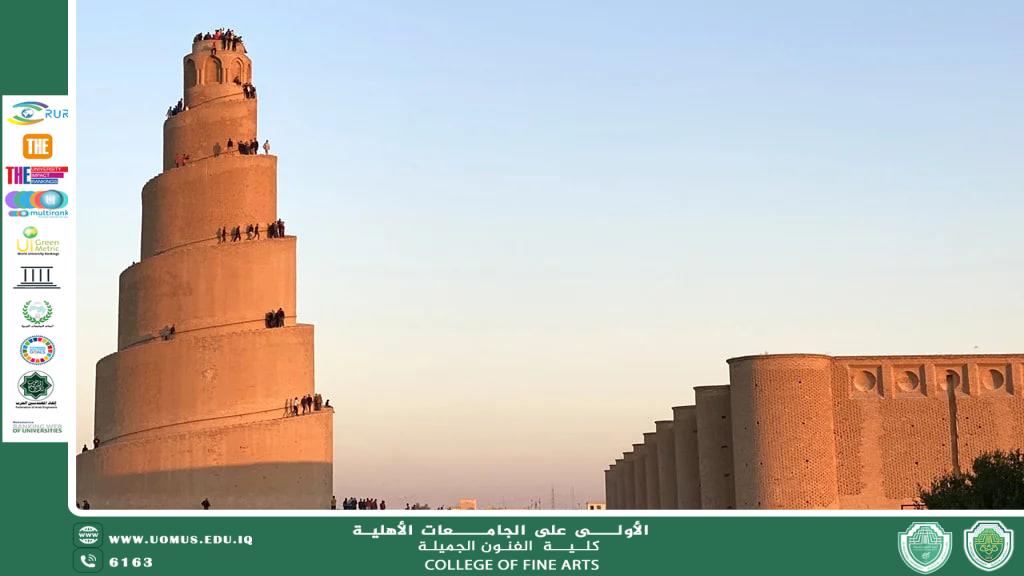
The Samarra Malwiya stands tall through the centuries as a symbol of Islamic architectural magnificence and the grandeur of a civilization that flourished along the Tigris River. It was built as the minaret of the Great Mosque commissioned by Caliph Al-Mutawakkil in 237 AH, and attributed to the Chaldean engineer Dahil Ya‘qub.<br />The Malwiya is a unique spiral minaret ascending counterclockwise from the base to the top, unlike traditional square or cylindrical minarets. It was constructed on a square base measuring 33 meters on each side with a height of 3 meters, above which rises a cylindrical body surrounded by an external spiral staircase reaching about 50 meters. Its decorations, including recessed rectangular niches, highlight an artistic and architectural brilliance.<br />Throughout history, the Malwiya faced significant challenges. It suffered neglect and damage due to modern conflicts, being used as a military post and partially blown up, which caused cracks and structural damage. Despite this, it has remained resilient, preserving its grandeur and continuing to attract visitors and researchers worldwide.<br />The Samarra Malwiya represents a bridge between past, present, and future. It contributes to achieving Sustainable Development Goals, particularly Goal 11: Sustainable Cities and Communities, by preserving cultural and architectural heritage and promoting historical tourism; Goal 4: Quality Education, by serving as an educational subject in history, architecture, and archaeology; and Goal 16: Peace, Justice, and Strong Institutions, by enforcing heritage protection and fostering cultural and social stability.<br /><br />Almustaqbal University, The First University in Iraq.