
“An Article Titled: Laminar Burning Velocity of Butane–Air Mixtures
15/11/2025 Share :
Prepared by: Assistant Professor Dr. Issam Mohi Mohammed
Administrative Deputy / College of Engineering Technologies
The laminar burning velocity of butane–air mixtures is one
of the fundamental parameters in combustion science, providing essential insights into flame-propagation behavior under calm and controlled conditions. Since butane gas (C₄H₁₀) is widely used as a gaseous fuel in domestic, industrial, and research applications, accurate knowledge of its combustion characteristics contributes to safer design, higher efficiency, and reliable modeling of thermal systems.
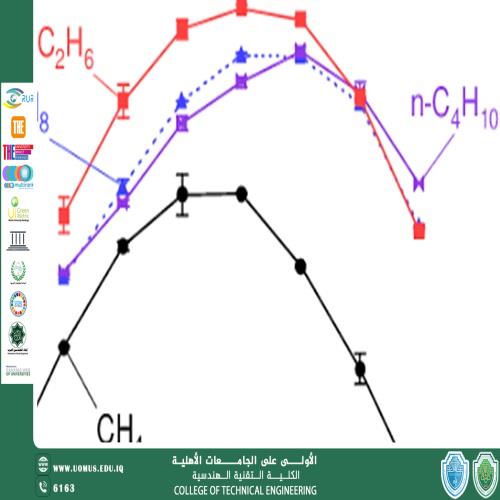
Laminar burning velocity represents the speed at which a flame front advances through a quiescent, unburned mixture of fuel and oxidizer. In butane–air mixtures, this velocity is influenced by several key factors, including the equivalence ratio (φ), pressure, temperature, and mixture composition. The highest laminar burning velocity typically occurs in slightly fuel-rich mixtures, where optimal chemical reactions and heat release are achieved.
Various techniques are used to measure laminar burning velocity, such as spherical flame expansion, heat-flux methods, and burner-stabilized flames. The spherical-flame method—using a constant-volume combustion chamber—is considered one of the most accurate approaches for gas-fuel measurements, as the true unstretched flame speed can be inferred from the flame radius and its rate of expansion.
Studies indicate that the maximum laminar burning velocity of butane–air mixtures under ambient conditions ranges between 35–40 cm/s, occurring at an equivalence ratio of approximately 1–1.1. Increasing pressure generally reduces the burning velocity due to greater heat-loss effects and changes in flame-thickness structure, while higher initial temperatures enhance chemical reaction rates and thus increase the burning velocity.
This parameter is crucial in combustion modeling, as it directly affects flame stability, pollutant formation, and engine performance. Engineers and researchers rely on laminar burning-velocity data to calibrate computational fluid-dynamics (CFD) simulations, improve burner designs, and assess explosion hazards in confined environments.
In summary, the laminar burning velocity of butane–air mixtures remains a key parameter in combustion research.