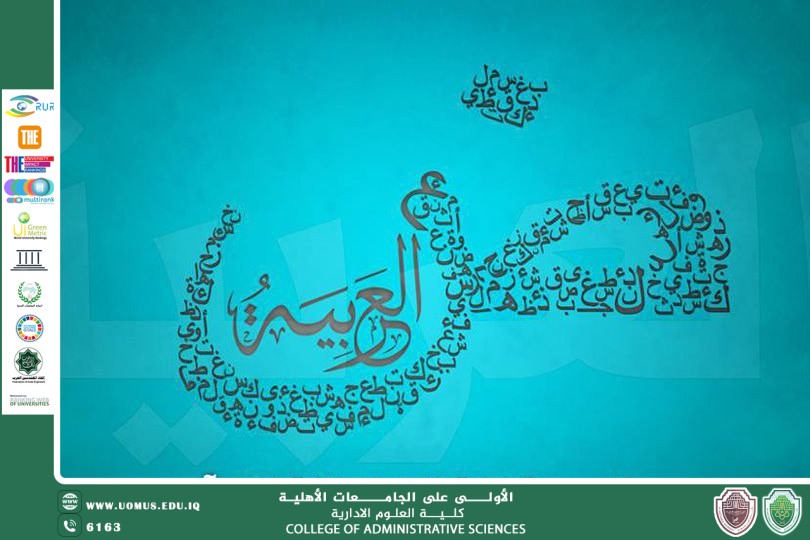

The Arabic Language and Its Relationship with Sciences and Sustainability: A Knowledge-Based Perspective on Its World Day
24/12/2025 Share :
Asst. Lec. Ahmed Mohammed Jawad
World Arabic Language Day, celebrated annually on December 18, representsan important cultural and intellectual occasion to reaffirm the distinguished status of the Arabic language among the languages of the world. Arabic is one of the six official languages of the United Nations and a civilizational vessel that, throughout its long history, has carried intellectual and scientific achievements that contributed significantly to shaping human awareness and progress.
The Arabic Language and Sciences: A Relationship of Integration and Mutual Influence
The Arabic language has never been merely a means of communication; rather, it has long been a language of science and knowledge. It played a fundamental role in the transmission and development of sciences, particularly during the golden age of Arab-Islamic civilization, when Arabic became the language of medicine, mathematics, astronomy, chemistry, philosophy, and the humanities. Works of earlier civilizations were translated into Arabic, further developed and enriched, and later transmitted to Europe, forming a foundation for its scientific renaissance.
The Arabic language is characterized by its high capacity for derivation and linguistic productivity, which enables it to absorb modern scientific concepts and formulate precise terminology across various disciplines, whether in natural, applied, or social sciences. Therefore, strengthening the presence of Arabic in scientific research and higher education constitutes a fundamental pillar for building solid knowledge rooted in cultural identity while keeping pace with global developments.
The Importance of the Arabic Language in Education and Knowledge Formation
The Arabic language plays a central role in the educational process, as it serves as a tool for comprehension, analysis, and critical thinking, and as a means for developing systematic reasoning among learners. Education in one’s mother tongue enhances deep understanding of scientific concepts, fosters creativity and innovation, and contributes to narrowing the knowledge gap. Moreover, caring for the Arabic language within academic institutions is an indicator of educational quality and a reflection of cultural belonging.
The Arabic Language and Sustainability: A Civilizational and Developmental Dimension
The relationship between the Arabic language and sustainability extends beyond the linguistic aspect to encompass a comprehensive civilizational dimension. Language constitutes a core component of sustainable development, particularly in its cultural and social dimensions. Preserving the Arabic language and expanding its use in science, media, and technology contribute to protecting cultural identity and promoting linguistic diversity, principles strongly emphasized in the Sustainable Development Goals.
Furthermore, the Arabic language plays a vital role in raising awareness of sustainability issues—such as environmental protection, food security, economic development, and social justice—through scientific, educational, and media discourse directed at society. Clear and effective language is capable of conveying complex concepts and reinforcing positive behaviors that support sustainability.
Conclusion
Celebrating World Arabic Language Day is not merely a symbolic occasion; rather, it is a renewed call to strengthen the status of this profound and ancient language across all spheres of life, particularly in science, academic research, and sustainable development. With its deep historical roots and structural flexibility, the Arabic language is capable of keeping pace with the modern age and actively contributing to the construction of a sustainable knowledge-based future, provided that institutional commitment and societal awareness of its pivotal role are firmly established.