How to Write a Graduation Project for Undergraduate Students (Fourth Year) Prepared by: Asst. Lecturer Abbas Hamza Khudair Department of Biochemistry College of Science – Al-Mustaqbal University
The graduation project represents the most important academic milestone in the undergraduate student’s educational journey, as it reflects the student’s ability to apply the theoretical and practical knowledge acquired throughout the years of study in producing a structured scientific work. The project aims to train students in the fundamentals of scientific research, enhance analytical thinking, develop academic writing skills, and promote organized and systematic work.
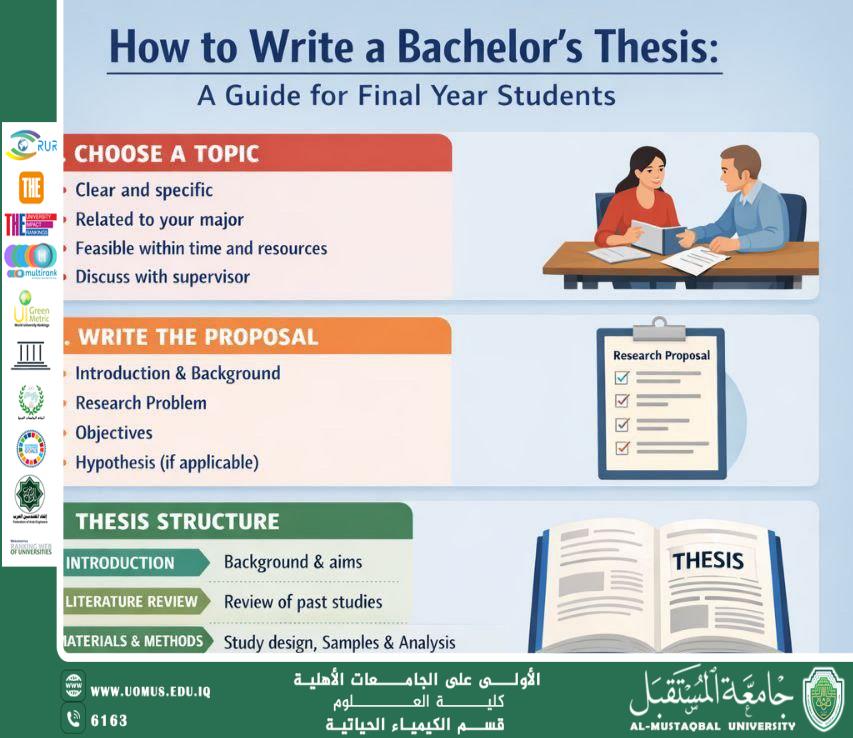
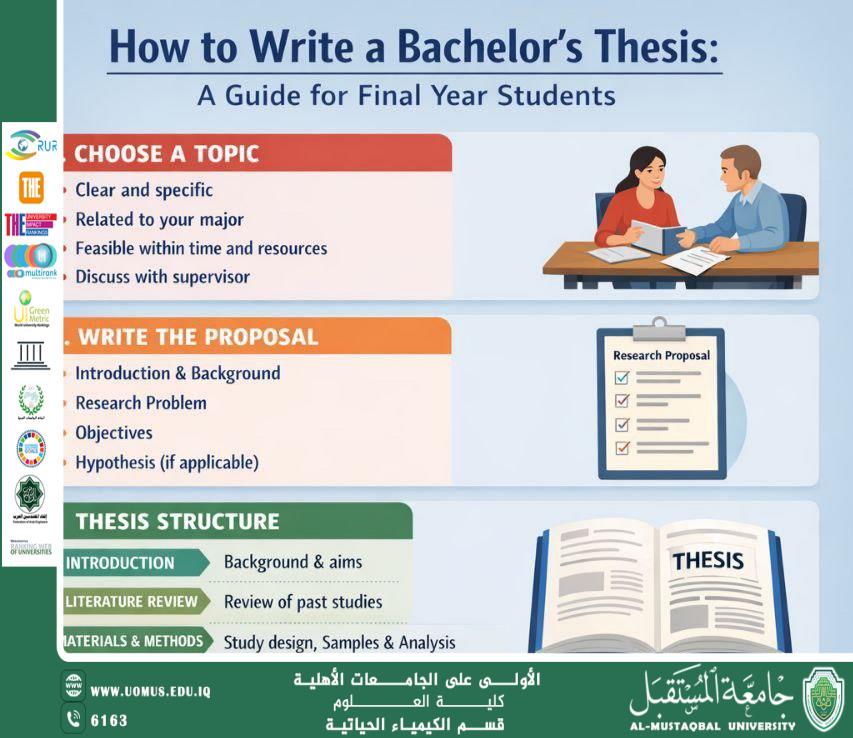
First: Selecting the Project Title
The graduation project title should be:
Clear and well-defined
Closely related to the student’s specialization
Feasible within the available time and resources
Of scientific or practical value
It is highly recommended that the title be selected in consultation with the academic supervisor to ensure its suitability in terms of scope and content.
Second: Writing the Project Proposal
The research proposal serves as the foundation upon which the graduation project is built and typically includes the following components:
1. Introduction
This section provides a brief scientific background of the topic, its importance, the rationale for choosing it, and an outline of the research problem.
2. Problem Statement
The research problem should be formulated scientifically, clearly identifying the knowledge gap or practical issue that the project aims to address.
3. Objectives of the Project
Objectives should be written as clear, achievable points, such as:
Measuring
Evaluating
Comparing
Analyzing
4. Research Hypothesis (if applicable)
A preliminary scientific assumption that can be tested through the study.
Third: Components of the Final Graduation Project
The graduation project usually consists of the following chapters:
Chapter One: Introduction
Includes a comprehensive background of the topic, the significance of the study, its objectives, and limitations.
Chapter Two: Literature Review
Presents a review of previous studies related to the topic, focusing on key concepts without direct copying or excessive quotation.
Chapter Three: Materials and Methods
This chapter describes:
Type of study
Samples or materials used
Instruments and tests
Statistical analysis methods
Chapter Four: Results and Discussion
Presentation of results using tables or figures
Interpretation of findings and comparison with previous studies
Chapter Five: Conclusions and Recommendations
Includes:
Major conclusions drawn from the study
Suggestions for practical applications or future research
Fourth: Academic Writing Style
Students should adhere to the following principles:
Use of clear and scientific language
Avoidance of plagiarism
Consistent formatting throughout the project
Use of reliable and credible scientific sources
Fifth: Referencing and Citations
All sources must be properly cited using an approved referencing style (such as Vancouver or Harvard), relying on:
Academic textbooks
Peer-reviewed scientific articles
Reputable academic journals
Sixth: Project Defense
The project defense provides an opportunity for students to demonstrate:
Their understanding of the research topic
Their ability to answer scientific questions
Their comprehension of the research methodology
Students are advised to thoroughly review their project and prepare for potential questions.
Conclusion
The graduation project represents the culmination of the undergraduate academic experience and plays a vital role in preparing students for scientific research or the job market. Adherence to scientific methodology, effective organization, and close collaboration with the academic supervisor are key factors in producing a distinguished graduation project that reflects the student’s academic level and the quality of the educational institution.
Al-Mustaqbal University
Ranked First among Iraqi Private Universities