The Role and Importance of Forensic Evidence and Its Relationship with Life Sciences Asst. Lect. Bushra Hussein Atiya
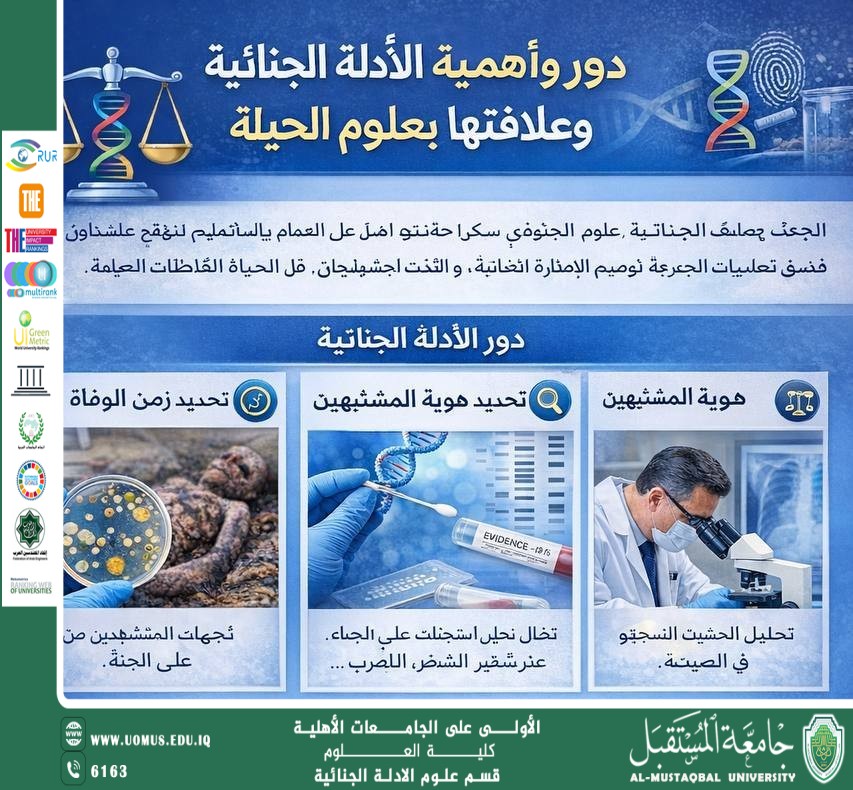
Forensic evidence is considered one of the most important scientific tools used in crime detection and the achievement of justice. This field has experienced significant development due to advances in life sciences. Disciplines such as genetics, microbiology, histology, physiology, and forensic entomology have contributed to providing precise tools that help analyze biological evidence and link it to individuals or events associated with a crime.
First: Concept of Forensic Evidence
Forensic evidence refers to a set of scientific and technical methods used to collect, analyze, and interpret physical and biological traces resulting from a crime, with the aim of uncovering the truth and supporting judicial decisions based on accurate scientific foundations.
Second: The Role of Life Sciences in Forensic Evidence
1- Genetics and DNA Analysis
DNA analysis is used to identify individuals with a very high degree of accuracy through the comparison of biological samples such as blood, saliva, hair, or skin cells. This technique plays a crucial role in linking suspects to crime scenes and exonerating innocent individuals.
2- Histology and Physiology
Histology contributes to determining the nature of injuries and the cause of death by examining cellular changes in tissues. Physiology helps explain the effects of injuries, toxins, or diseases on different body systems.
3- Forensic Entomology
Forensic entomology relies on the study of insects found on human remains and their developmental stages to estimate the post-mortem interval, which is essential for determining the time of death.
Third: Importance of Integration Between Life Sciences and Forensic Evidence
The integration of life sciences with forensic evidence enhances the accuracy of criminal investigations, reduces errors, protects human rights, and supports justice through scientifically reliable methods.
Conclusion
Life sciences represent a fundamental pillar in the development of modern forensic evidence. With continuous scientific and technological advancements, their role in supporting criminal justice and maintaining public security will continue to grow.
Al-Mustaqbal University – the first university in Iraq.
SDG4