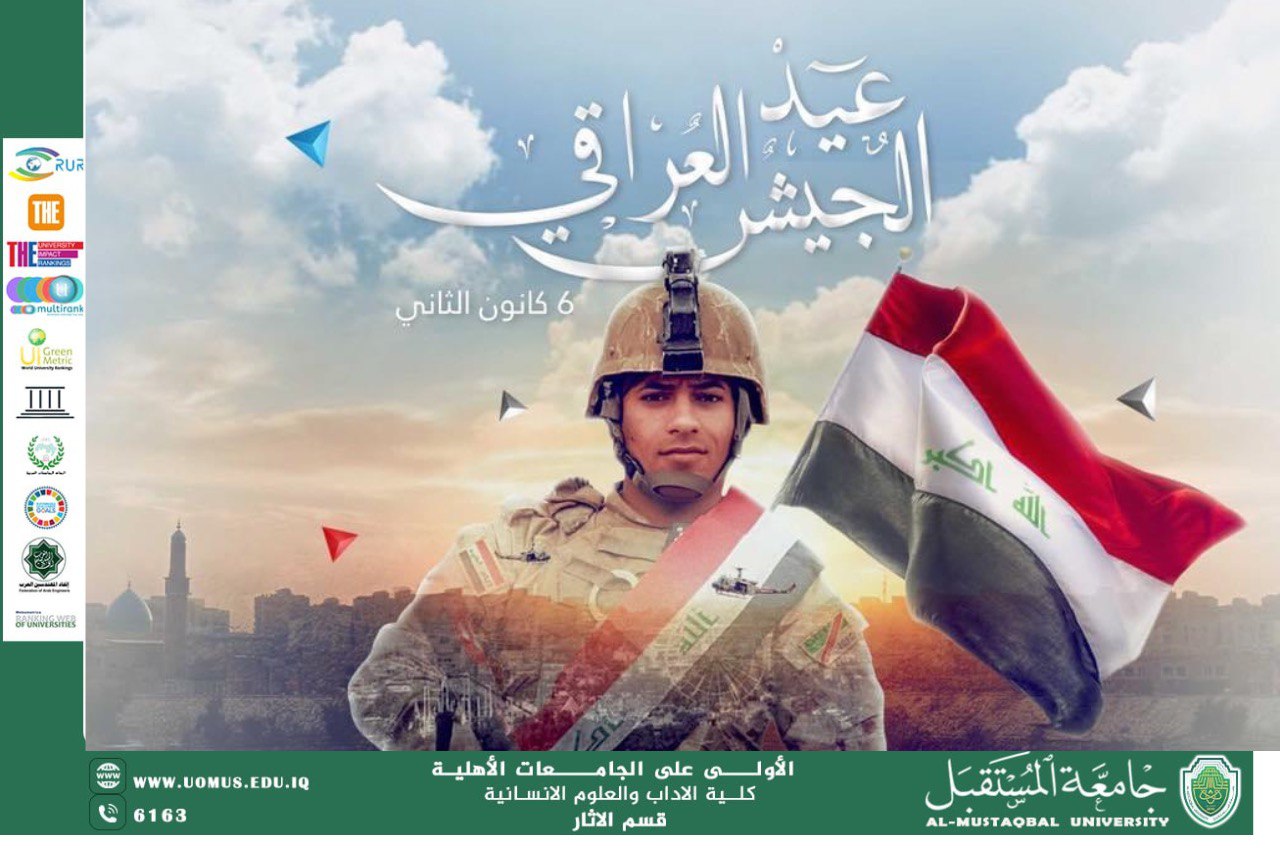
Article by Dr. Angham Salim Al-Dulaimi, Head of the Department of Archaeology, on “The Eternal Army”
The Iraqi army is considered one of the oldest armies in the history of humanity, as its roots extend back to the dawn of civilization in Mesopotamia, where the first cities and organized states emerged. Sumerian and Babylonian cuneiform texts reveal the pivotal role of the military institution in building the state, protecting society, and establishing the concepts of sovereignty and order. This makes the modern Iraqi army a continuous and unbroken civilizational extension.
In the Sumerian era, the army was closely linked to political and religious authority. The king, known by the title Lugal, was the supreme commander of the army and the legitimate representative of the will of the gods on earth. Cuneiform texts indicate that the army’s mission was not limited to warfare alone, but also included protecting cities, securing agricultural lands, and defending the resources of life.
Sumerian texts clearly expressed this idea in a laudatory passage:
uru lugal-ki šag₄-ge me-en du₁₀-ga
(I am the guardian of the king’s city; I stand with strength and righteousness).
This text confirms that the Sumerian soldier was viewed as the protector of the city and a pillar of its survival, not merely a fighter. Artistic historical reliefs, such as the Stele of the Vultures, depict soldiers lined up in organized formations carrying spears and shields, clearly indicating the existence of a disciplined and organized army.
Cuneiform texts also emphasize that war in Sumerian thought was a sacred act, waged by the will and under the patronage of the gods. The army was directly associated with the god Enlil, the god of authority and cosmic order, as stated in one of the texts:
dingir Enlil ki-ge me-en ḫe₂-ti-la
(By the will of the god Enlil, we stand alive and strong).
This passage reflects the Sumerians’ belief that the survival of the city and the victory of the army depended on divine approval, and that soldiering was a sacred mission before being a military duty.
With the rise of the Babylonian state, especially during the reign of King Hammurabi, the army developed in terms of organization and administration. Administrative and legal texts reveal the existence of military registers, the regulation of military service, and the granting of land to soldiers in return for their commitment to defending the state. The Babylonian army was associated with the god Marduk, the symbol of the state and legitimacy, as stated in the texts:
ina šum Marduk ummânu išakkan
(In the name of Marduk, the army establishes victory).
This text clearly shows that military power was regarded as a means of achieving justice and maintaining order, a concept also emphasized in the prologue to the Code of Hammurabi, which links military victory with societal stability.
We may also add the distinguished status held by the Iraqi soldier as the protector of the land, as indicated in Babylonian cuneiform texts, where it is explicitly stated:
ṣābu niṣir mātim
(The soldier is the guardian of the land and the homeland).
Reading these cuneiform texts reveals that the values upon which the ancient Iraqi army was founded—such as discipline, sacrifice, and loyalty to the land—are not recent, but rather part of a deeply rooted civilizational system. The modern Iraqi army carries this ancient heritage and continues its role in protecting the الوطن and safeguarding its sovereignty.
In conclusion, from the soldiers of Sumer and Babylon who recorded their heroism on clay tablets, to the soldiers of Iraq today who defend the homeland with their blood, one message continues across thousands of years. It can be summarized in a timeless symbolic phrase:
ki-ge me-en ṣābu dāru
(We remain… an eternal army).
Thus, the Iraqi army remains the civilization of the homeland, a living witness to the greatness of Iraq, the guardian of its history, and an extension of the first human who bore arms in defense of land and life.