The Difference Between the Open and Closed Taa
Prepared by M.M. Liqaa Abbas Dhair
The letter taa at the end of words is a fundamental aspect of Arabic spelling.
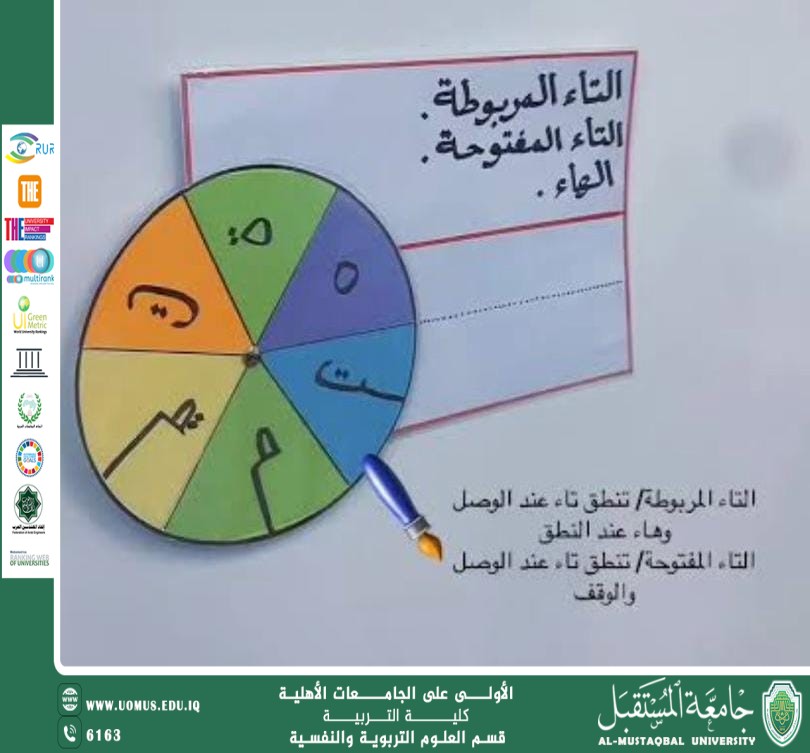
Its form is divided into two main types: the open taa (تاء مفتوحة) and the closed taa (ة). The essential difference between them lies in their pronunciation when pausing and when continuing a word. This is the most accurate criterion for distinguishing between them and avoiding common writing errors.
The open taa is defined as the taa that remains clearly pronounced with the "taa" sound, whether the word is read in isolation with a pause or within a sentence. This taa appears in various positions, including at the end of verbs, whether it is a root letter like "بات" (baata), the taa of the subject like "قرأتُ" (qara'tu), or the taa of the feminine plural like "كتبتْ" (katabat). It is also found in the feminine plural like "طالبات" (talibat) and in three-letter nouns with a silent middle letter like "بيت" (bayt) and "وقت" (waqt).
The open taa is pronounced with a silent middle letter. The ta' marbuta (ة) is the letter "ta" that is pronounced as "ta" when a word is connected to the following word, but it changes to a silent "ha" when it is at the end of a word. The ta' marbuta only appears in nouns, and its common occurrences include the singular feminine noun, such as "shajara" (tree) and "hadeeqa" (garden), and some broken plurals whose singular form does not end in an open ta', such as "qudat" (judges) and "ru'at" (shepherds). The ta' marbuta is distinguished by the presence of two dots above it to differentiate it from the ha' of the third person singular pronoun, which is added to words.
To differentiate between them simply, one can pause on the word with a silent "ta" (ت). If the sound of the "ta" changes to "ha," it is a "ta' marbuta," as in the word "madrasa" (school), which is pronounced "madrasa" when at the end of a word. However, if the sound of the "ta" remains clear and cannot be changed to "ha" without corrupting the word, it is an "ta' maftuha" (open ta'), as in the word "bint" (girl), which cannot be pronounced "binah." Mastering these rules enhances the quality of writing and preserves the integrity and beauty of the Arabic language and its spelling.
AL_Mustaqbal University… where knowledge is built and hope is shaped.