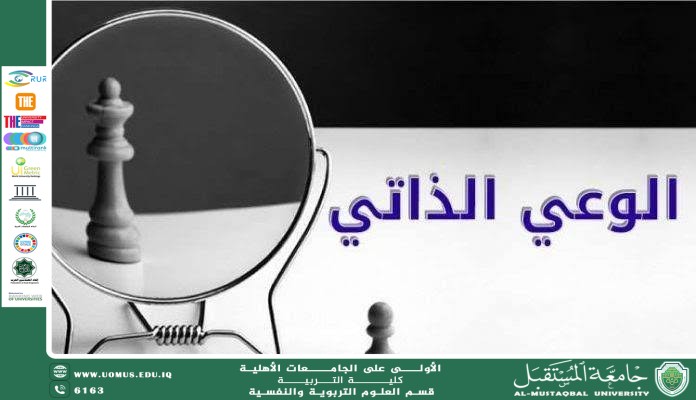

Self-Awareness
Prepared by: Dr. Haider Kadhim Mawla
Self-awareness is one of the most important psychological skills an individual can acquire. It is not only a tool for self-understanding, but also a cornerstone for achieving psychological and emotional balance and making sound decisions that lead to personal and professional growth. In this era, where daily life is full of challenges and work pressures, self-awareness becomes more important than ever.
Self-awareness allows us to get to know ourselves better and understand the impact of our behaviors and feelings on our daily lives. It helps us build healthy relationships, deal with stress effectively, and achieve success in various areas of life. Self-Awareness... The Pulse Where Science and Spirit Meet
Self-awareness is a moment of perception where science meets emotion, a moment of self-disclosure. When the mind monitors its activity and becomes aware of its effect on sensation in the brain, the default mode network is activated, drawing an accurate cognitive picture of the "self," while the medial prefrontal cortex works to evaluate behavior and regulate emotion. However, these neural processes are not simply a matter of electricity and chemistry; It is the biological manifestation of a profound emotional event. In that moment, presence expands, and the psyche begins to separate feeling from identity. Anger is seen as a transient state, not an inherent trait, and fear is understood as a physiological stimulus that can be calmed through breathing or cognitive reappraisal. Thus, self-awareness intertwines with emotional regulation. The amygdala's responses diminish when consciously observed, and the prefrontal cortex is activated to restore balance between emotion and thought. This interplay between neural perception and conscious attention is what makes self-awareness an internal healing tool, rather than an acquired skill.
Self-awareness is the process of an individual becoming aware of their own thoughts, feelings, and motivations. It is the ability to look inward and reflect on our actions and behaviors in an unbiased manner. Self-awareness is not merely thinking about oneself; it is the ability to observe and analyze our behaviors objectively. This awareness includes engaging with our emotions and monitoring our reactions to different situations.
At a deeper level, self-awareness is not a state of separation but of harmony. To see yourself not to judge yourself, but to embrace yourself with the eyes of the world and the heart of humanity—this is a balance between analysis and compassion, between observation and acceptance. Every moment of self-awareness reshapes neural connections and revitalizes neuroplasticity, transforming understanding into a healing process, not merely knowledge. Thus, self-awareness shifts from a purely intellectual concept to a spiritual and scientific practice: observing your thoughts, listening to your body, and seeing your heart, without being biased towards any one of them. "Self-awareness is to dwell within yourself as light dwells within glass: passing through it, illuminating it, without clinging to it."
Types of Self-Awareness:
Self-awareness can be divided into two main types:
1- Inner Self-Awareness: This is the ability to understand and interpret our inner thoughts and feelings, and to seek their meaning and motivations. This type of self-awareness can help us develop a deeper understanding of ourselves. People with strong inner self-awareness are usually more aligned with their personal goals, principles, and values.
2. External Self-Awareness: This type of self-awareness relates to the ability to understand how others perceive us. People with strong external self-awareness have a clear understanding of how their behavior affects others. They interact in balanced relationships and can adjust their actions to meet others' expectations without losing their authenticity.
Importance of Self-Awareness:
• Better Decision-Making: Helps in making informed decisions rather than reacting impulsively.
• Healthier Relationships: Improves personal and professional relationships through a deeper understanding of yourself and others.
• Effective Leadership: A cornerstone of emotional intelligence and successful leadership.
• Improved Performance: Helps improve professional performance through self-monitoring and error correction.
• Emotional Resilience: Enables better emotional management and overcoming challenges with greater confidence.
In conclusion, self-awareness is an ongoing process that doesn't stop at any particular stage. It is a powerful tool that helps in self-improvement, achieving personal and professional success, and building healthy and balanced relationships. By developing self-awareness, we can live a more balanced and fulfilling life, becoming more in control of our actions and achieving our goals.
ِAL_Mustaqbal University... solid knowledge, and hope that shapes tomorrow.