Scientific Article for the Department Course Titled: Applications of Intense Pulsed Light and Laser Technologies (SPL) in Hair Removal
Introduction
Hair removal technologies have undergone significant development over recent decades. Laser and IPL devices have become effective and relatively safe alternatives to traditional hair removal methods. The success of these techniques depends on a thorough understanding of light–tissue interaction, particularly the role of melanin in hair and skin.
Mechanism of Action
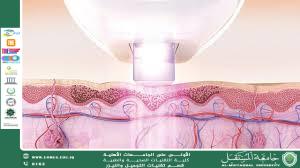
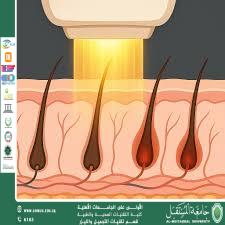
Hair removal using SPL relies on the absorption of light energy by melanin present in hair follicles. Once absorbed, the light energy is converted into heat, which damages the stem cells located in the bulge area of the follicle, responsible for hair regeneration. This process occurs while largely preserving the surrounding tissues, in accordance with the principle of selective photothermolysis.
Factors Affecting Treatment Success
1. Hair Color
These technologies are most effective on dark, coarse hair due to its high melanin content, which allows greater absorption of light energy. In contrast, light-colored or gray hair responds poorly because of its low melanin concentration, making it difficult to target effectively.
2. Skin Color
Skin color plays a crucial role in selecting the appropriate device and wavelength. Lighter skin types can be treated using shorter wavelengths, while darker skin types require longer and safer wavelengths, such as the Nd:YAG laser (1064 nm), to minimize epidermal melanin absorption and reduce the risk of burns or pigmentation disorders.
3. Hair Growth Cycle
Hair grows in three main phases: anagen (growth phase), catagen (regression phase), and telogen (resting phase). Laser and IPL hair removal are effective only during the anagen phase, when the hair shaft is connected to the follicle and contains the highest concentration of melanin. Therefore, multiple treatment sessions spaced over time are required to target the maximum number of follicles during this phase.
Role of Cooling Systems
Cooling systems are an essential component of modern hair removal devices. They protect the epidermal layer from excessive heat, reduce pain during treatment, and minimize side effects such as burns, erythema, and post-inflammatory hyperpigmentation. Effective cooling significantly enhances patient comfort and procedural safety.
Conclusion
SPL-based laser and IPL technologies represent effective long-term solutions for hair removal when appropriate patient selection and proper treatment parameters are applied. Treatment success depends on several factors, including hair color, skin type, hair growth cycle, and the use of efficient cooling systems. With continuous technological advancements, these methods are expected to become even safer and more effective in future clinical practice.
AL_mustaqbal University is the first university in Iraq