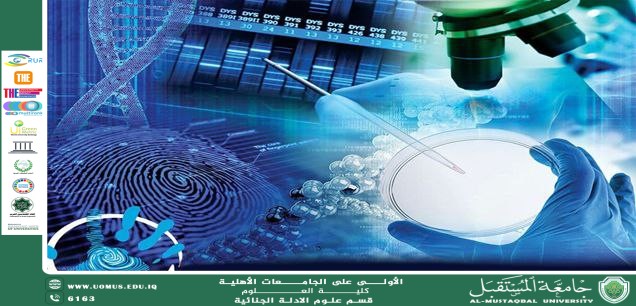

The Role of Biology in Modern Forensic Evidence (Asst. Lecturer Huwayda Nazzal Hussein)
Introduction
Life sciences, particularly biology, have become essential components of modern forensic investigations. As crimes grow more complex, traditional investigative methods alone are no longer sufficient. Biology provides scientific tools that help analyze physical evidence and reconstruct criminal events accurately.
Biology and the Crime Scene
A crime scene is any location where a crime occurred or where evidence related to it is found. Biology plays a key role in examining biological traces such as:
Bloodstains
Hair
Saliva
Skin cells
Human tissues
Even when these traces are invisible to the naked eye, biological techniques allow their detection and analysis.
Role of Biology in Human Identification
Biology contributes significantly to identifying suspects and victims through cellular and biological characteristics. Each human cell contains unique biological information that can link an individual to a crime scene or exclude them scientifically.
This has greatly reduced judicial errors, especially in cases relying solely on circumstantial evidence.
Estimating Time of Death through Biological Changes
One of the most important forensic applications of biology is studying post-mortem biological changes, including:
Cellular decomposition
Tissue discoloration
Microbial activity
These changes help estimate the time of death, which is crucial for reconstructing criminal timelines.
Importance of Biology in Achieving Justice
Biological evidence provides objective and reliable information in court, unaffected by emotions or external pressure.
For this reason, biology has become an integral part of modern forensic justice systems and has helped solve many complex cases.
Conclusion
Biology is no longer a purely theoretical science; it is a practical and powerful tool in the pursuit of justice. With continuous scientific advancements, its role in forensic investigations will continue to expand and improve.
Al-Mustaqbal University – the first university in Iraq.
SDG4