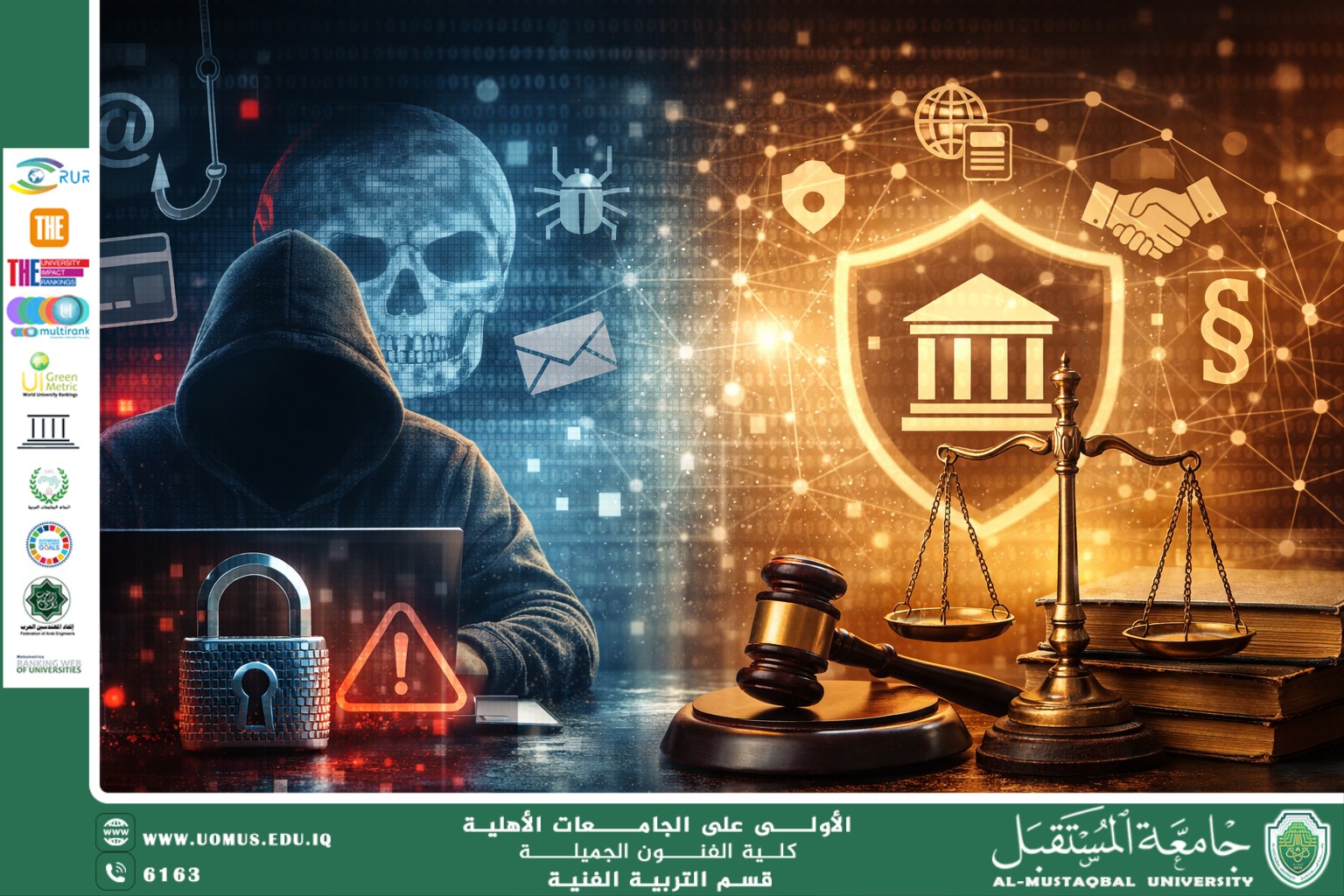

Cybercrime and the Challenges of Legal Legislation in the Era of Digital Transformation by Programmer Sarah Faiq Ali
The rapid advancement of information and communication technologies has led to profound transformations in patterns of life and work, expanding cyberspace as a new arena for human, economic, and cultural interaction. However, this development has been accompanied by a significant rise in cybercrime, which has become a serious threat to social, economic, and legal security at both national and international levels.
Cybercrime encompasses a wide range of illegal activities, including online financial fraud, digital identity theft, hacking of governmental and banking systems, cyber extortion, cyber espionage, and the distribution of malicious software. The danger of these crimes lies in the fact that they are committed within a virtual environment that transcends geographical borders, granting perpetrators a high level of anonymity and making legal tracking and prosecution extremely difficult.
Legal legislation represents one of the most important pillars in confronting cybercrime; however, it faces multiple challenges, foremost among them the inability of existing laws to keep pace with technological developments. Many traditional legal frameworks were designed to address tangible, conventional crimes, whereas cybercrimes are characterized by complexity and continuous evolution, necessitating flexible and regularly updated legal systems.
Another major challenge is the legal proof of cybercrime, as investigations rely heavily on digital evidence that requires advanced technical expertise to preserve, analyze, and authenticate. This challenge is compounded by the need for robust digital and judicial infrastructures capable of dealing efficiently with such crimes. In addition, international judicial cooperation is often hindered by differences in legal systems and varying definitions of cybercrime across countries.
Equally significant is the challenge of protecting digital rights and privacy, as legislators must strike a delicate balance between strengthening cybersecurity and preventing violations, while simultaneously safeguarding individuals’ rights to privacy and data protection against misuse or unlawful surveillance.
In light of these challenges, there is an urgent need to adopt comprehensive strategies to combat cybercrime. Such strategies should include updating legal frameworks, building specialized human capacities in cybersecurity and digital forensics, enhancing regional and international cooperation, and promoting legal and cyber awareness among members of society, particularly youth and university students.
These efforts are aligned with Sustainable Development Goal 16 (Peace, Justice, and Strong Institutions), which emphasizes the importance of building effective, accountable institutions, strengthening the rule of law, and ensuring access to justice for all. Combating cybercrime through effective legislation and advanced legal systems contributes to enhancing public trust in institutions, protecting societies from digital threats, and supporting stability and sustainable development.
In conclusion, cybercrime is no longer merely a technical issue; it has become a legal and societal challenge that requires the integration of legislative, technological, and awareness-based efforts to build a secure digital environment capable of keeping pace with digital transformation, protecting individual rights, and achieving sustainable development...Almustaqbal University, The First University in Iraq.