Classical Arabic Between the Past and the Present (Asst. Prof. Sarab Abbas Jasim)
Classical Arabic is one of the oldest living languages in the world and has played a vital role in shaping Arab and Islamic civilization. Since its early emergence, it has been closely connected to literature, culture, and intellectual life. With the revelation of the Holy Qur’an in Arabic, the language gained a unique and sacred status. Throughout history, Classical Arabic flourished, yet in the modern era it faces several challenges that require careful study of its position between the past and the present.
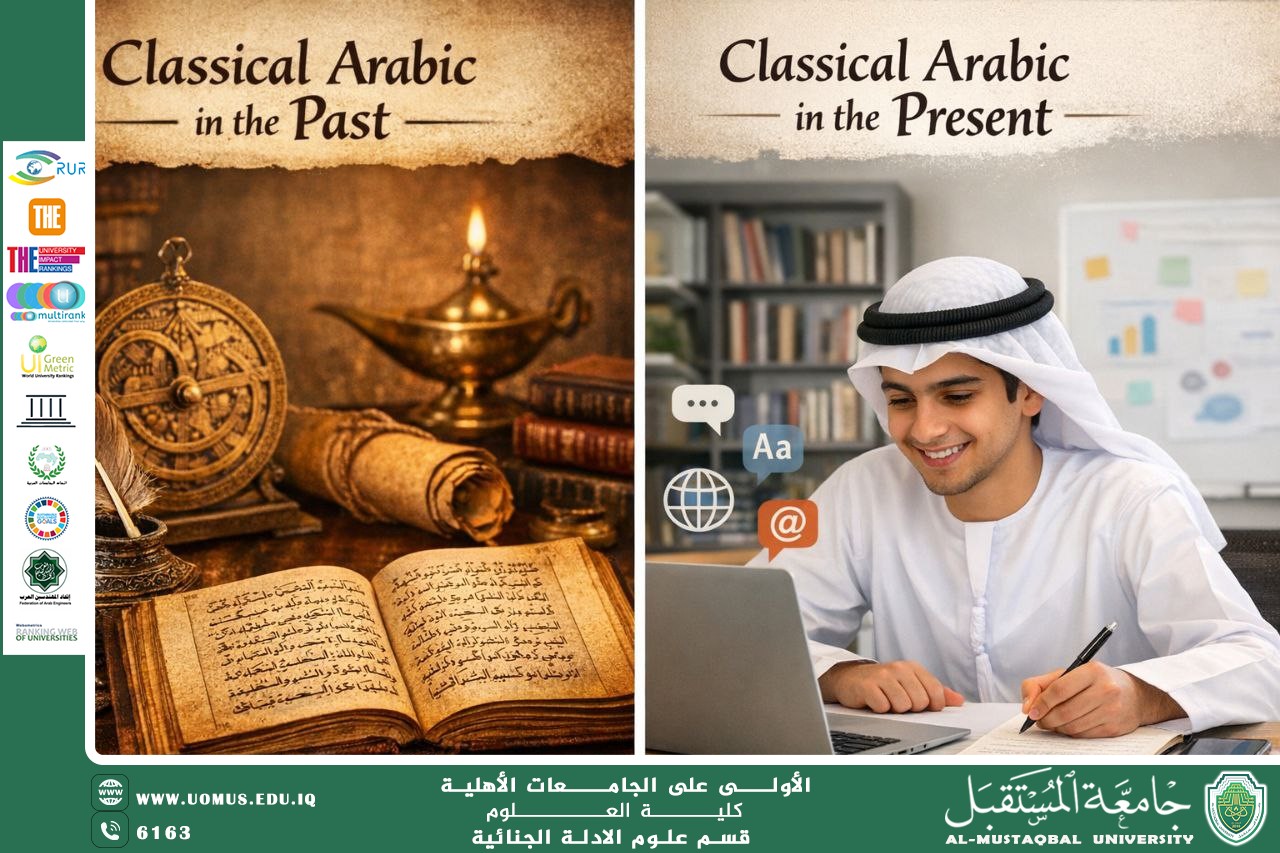
Classical Arabic in the Past
In the past, Classical Arabic held a prestigious position as the language of poetry, eloquence, and official communication. During the Islamic eras, especially the Umayyad and Abbasid periods, it reached its peak. Scholars used Classical Arabic to record sciences such as grammar, morphology, rhetoric, philosophy, medicine, and mathematics. Linguistic rules were established to protect the language from error and distortion, which helped preserve its purity and continuity across generations.
Classical Arabic in the Present
Today, Classical Arabic remains the official language of Arab countries and the primary language of education, media, and formal writing. However, it faces many challenges, including the widespread use of colloquial dialects, the dominance of foreign languages, and the influence of social media on language use. These factors have contributed to a noticeable decline in the everyday use of Classical Arabic, particularly among younger generations.
Between Authenticity and Modernity
Despite these challenges, Classical Arabic has shown great flexibility and an ability to adapt to modern life. Its rich system of derivation enables it to create new terms that meet contemporary scientific and technological needs. The real challenge lies in balancing the preservation of its linguistic authenticity with the modernization of teaching methods and practical usage, ensuring that it remains a living and effective language.
Conclusion
Classical Arabic stands as a bridge between a rich past and a changing present. It represents the cultural and intellectual identity of the Arab nation, and preserving it is a shared responsibility. Through education, awareness, and active use, Classical Arabic can continue to thrive and express human thought across different eras.
Al-Mustaqbal University – the first university in Iraq.
SDG4