Scientific Article Recent Innovations in Energy-Efficient Refrigeration and Air Conditioning Systems Prepared by: Asst. Lect. Esraa Hussein Amwaishi
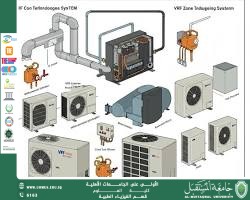
1. IntroductionWith the continuous rise in global temperatures, the demand for cooling has become an indispensable necessity. Recent innovations focus on breaking the vicious cycle between increased cooling and rising carbon emissions by integrating smart technologies and advanced materials to reduce energy consumption by rates ranging from 30% to 50%.2. Innovative Technologies in Energy SavingA. Variable Refrigerant Flow (VRF) Systems: VRF technology represents a qualitative leap in efficiency. Instead of operating on a traditional "on/off" basis, the system independently controls the amount of refrigerant flowing to each indoor unit based on the actual needs of the room.Practical Advantage: Massive energy savings when operating only specific parts of a building.B. Indirect Evaporative Cooling: This technology relies on cooling the air without increasing its humidity using advanced heat exchangers.Application: Ideal for dry regions, consuming 80% less energy compared to traditional vapor compression systems.C. Magnetic Refrigeration: A promising technology based on the "magnetocaloric effect," where the temperature of certain materials rises when exposed to a magnetic field and falls when removed.Environmental Importance: It does not use refrigerants harmful to the environment and provides very high energy efficiency.3. Integration of Artificial Intelligence (AI) and the Internet of Things (IoT)In line with the Digital Transformation and Artificial Intelligence Forum held at Al-Mustaqbal University, smart algorithms play a pivotal role in:Predictive Maintenance: Predicting malfunctions before they occur to maintain motor efficiency.Smart Control: Adjusting temperatures based on room occupancy and external weather forecasts.4. Green RefrigerantsThe focus has shifted from using ozone-depleting chlorofluorocarbons to natural refrigerants such as Ammonia ($NH_3$) and Carbon Dioxide ($CO_2$). These refrigerants are characterized by a high Coefficient of Performance ($COP$), meaning more cooling with less energy consumption.5. Applied Study: Air Conditioning and Refrigeration Techniques Department at Al-Mustaqbal UniversityThe department's achievement of first place in the Iraqi National Ranking for three consecutive years is a testament to its leadership in this field. Applied studies at the university include:Solar Energy Utilization: Linking air conditioning systems to solar panels to reduce dependence on the national grid.Advanced Thermal Insulation: Studying the impact of modern insulators in reducing thermal loads on air conditioning units within the university's new buildings.6. Conclusion and RecommendationsThe future of cooling lies in "Digitization" and "Sustainability." To achieve maximum benefit, we recommend:Upgrading old systems with Inverter systems.Relying on smart buildings that employ natural thermal insulation.Continuing to support scientific research in alternative energy fields, as demonstrated by Al-Mustaqbal University.
Al-Mustaqbal University is the first university in Iraq.