Scientific Article: Prompt Engineering – The Science Behind Artificial Intelligence Language By Noor Firas
1. Introduction
Prompt Engineering represents the process of optimizing the formulation of inputs (prompts) to guide Artificial Intelligence models (such as GPT-4 or Gemini) toward producing more accurate and relevant outputs. This process is not limited to "writing requests"; it is a cognitive engineering discipline based on a deep understanding of probabilistic model structures and how they process linguistic data.
2. Core Pillars of Prompt Engineering
To obtain a rigorous scientific result, a prompt must include the following elements:
Role: Defining the AI's persona (e.g., "Answer as a professor specialized in Medical Physics").
Context: Providing necessary background information to narrow the scope of the inquiry.
Task: Clearly defining the required action (Analyze, Summarize, Program).
Constraints: Specifying word count, language, or required format (Tables, Bullet points).
3. Advanced Prompting Strategies
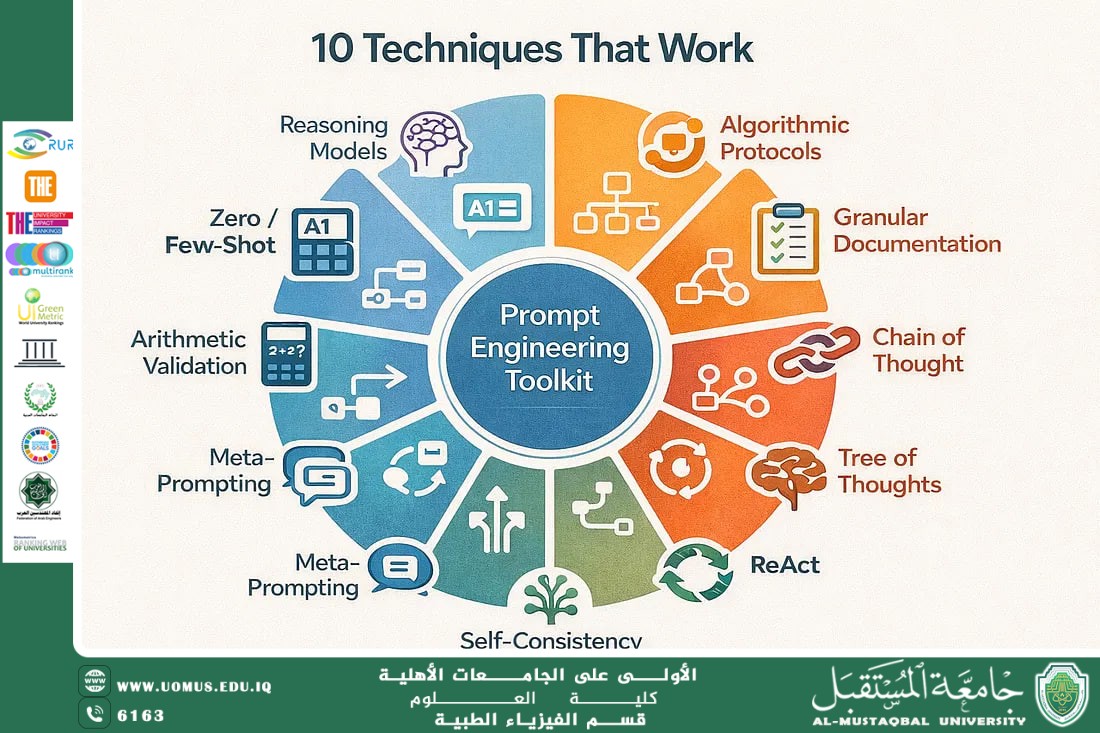
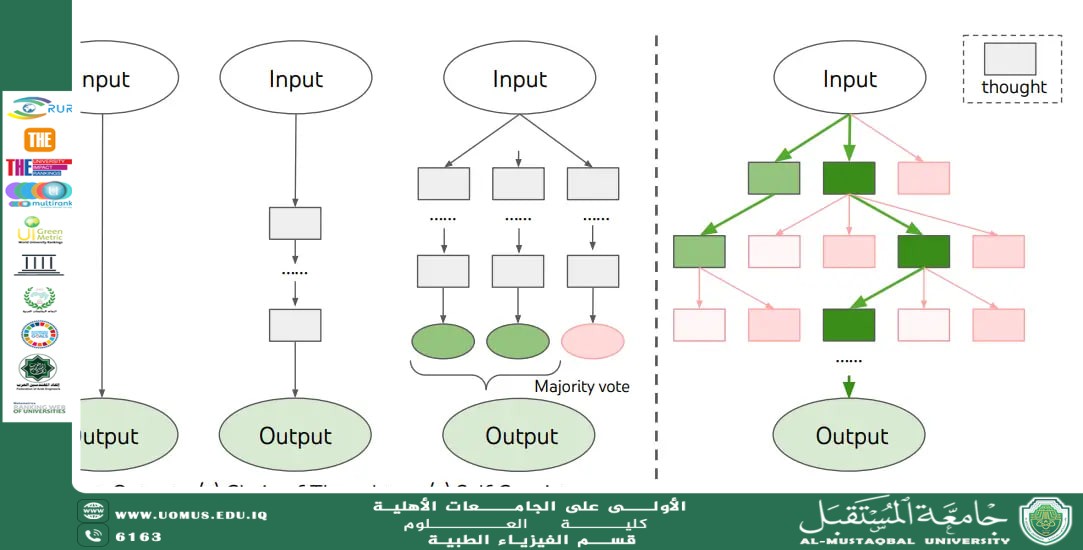
A. Chain-of-Thought Prompting: This strategy relies on requesting the AI to "think aloud." Instead of requesting the result directly, the model is asked to break down the problem into logical steps.
Importance: This method significantly increases the accuracy of models in solving complex mathematical and logical problems.
B. Few-Shot Prompting: This involves providing the model with previous examples of the desired pattern before posing the final question.
Example: Providing the model with three examples of translating medical terms, then asking for the translation of a fourth term.
C. Zero-Shot Prompting: This is the model's ability to answer a task without having been specifically trained on examples beforehand, relying solely on the vast knowledge stored within its weights.
4. Prompt Engineering in Scientific Research (Academic Perspective)
In leading institutions such as Al-Mustaqbal University, prompt engineering is used to advance scientific research through:
Hypothesis Generation: Formulating prompts that drive AI to bridge disparate scientific fields (e.g., linking AI algorithms with refrigeration techniques).
Literature Review: Writing precise prompts to extract research gaps from hundreds of scientific articles in seconds.
Debugging Code: Engineering prompts targeted at programmers to ensure the writing of code free from logical errors.
5. Challenges and Ethics
Despite the power of this discipline, it faces challenges such as:
Hallucination: The tendency of models to generate incorrect information if the prompt is not structurally supported by context.
Bias: Imprecise prompts may invoke hidden biases within the model's training data.
6. Conclusion and Recommendations
Prompt Engineering is the "new programming language." To achieve maximum benefit in the academic community, we recommend:
Integrating workshops on prompt engineering within the digital skill development programs at the university.
Focusing on Iterative Testing, as the first prompt is rarely the best.
Utilizing "Prompt Templates" tools to standardize the quality of research outputs.
"AL_mustaqbal University is the first university in Iraq"