A scientific article entitled Multi-agent Systems (M.M. Aya Muhammad Ali Muhammad Hussein)
Multi-Agent Systems
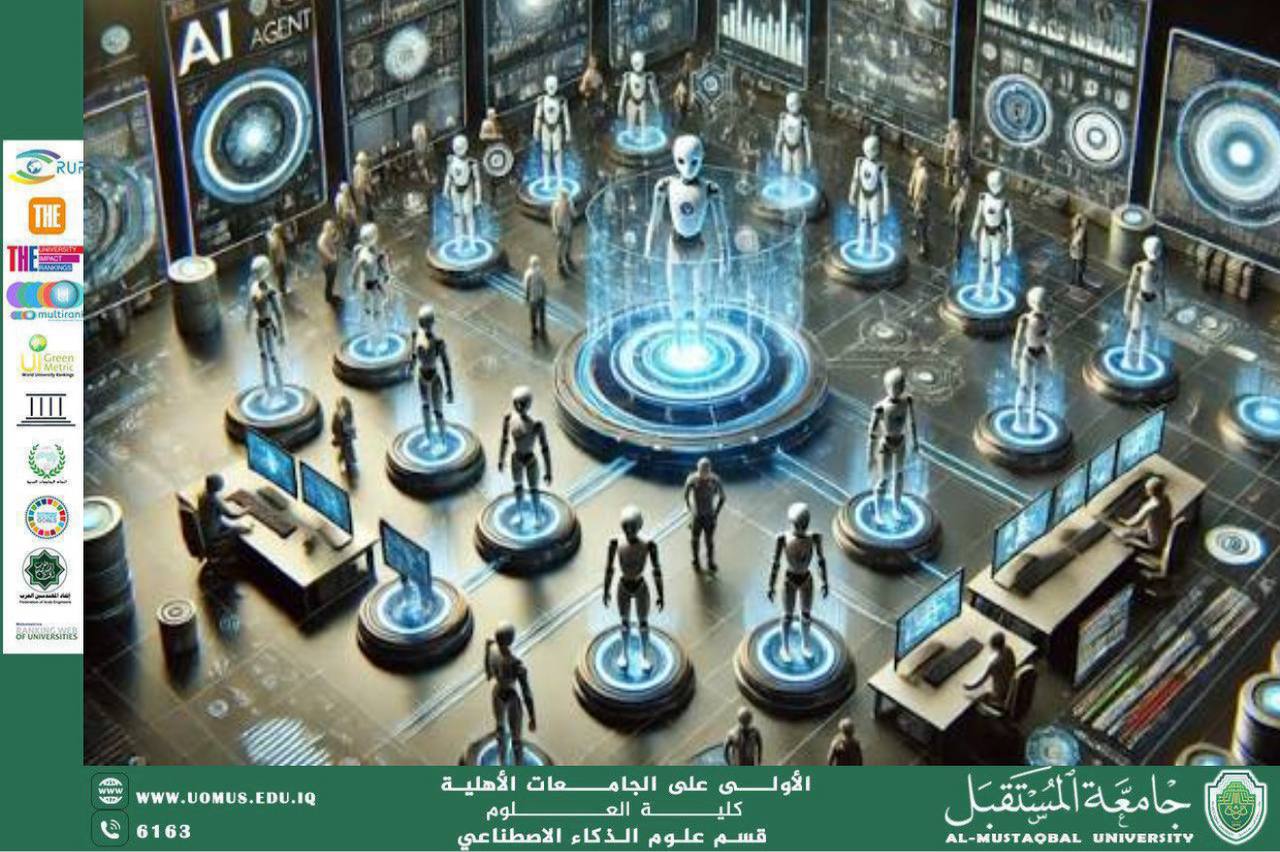
Multi-Agent Systems (MAS) represent an advanced branch of Artificial Intelligence in which multiple intelligent agents interact with each other and their environment to achieve individual or collective goals. An intelligent agent is a computational entity capable of perception, decision-making, and autonomous action. When multiple agents operate within a shared environment, they form cooperative or competitive systems that resemble real-world social and economic structures.
Multi-agent systems are applied in various domains, including intelligent traffic management, network control, e-commerce platforms, strategic games, and economic simulations. For example, in intelligent transportation systems, each agent may represent a traffic signal or vehicle, making real-time decisions based on environmental data to improve traffic flow and reduce congestion.
These systems rely on coordination, negotiation, and cooperative learning algorithms. Agents may exchange information and adapt dynamically to environmental changes. Multi-agent reinforcement learning techniques are increasingly used to develop optimal strategies in complex and decentralized environments where no single central controller exists.
Multi-agent systems provide a powerful framework for building scalable, flexible, and adaptive intelligent solutions, particularly in dynamic and distributed settings. Consequently, this field remains a significant research direction in AI, enabling the simulation of collective behavior and the optimization of cooperative systems.