"Exorbitant Dowries"
Prepared by Prof. Dr. Thanaa Bahaa El-Din Abdullah
Our article today addresses a highly important and serious social issue that
affects our young men and women and threatens the very foundation of the Muslim family before it is even established. It is the issue of "exorbitant dowries" and their negative consequences, most notably the spread of the phenomenon of "spinsterhood" among women.
Marriage in our pure religion is not merely a social custom, but rather the tradition of the prophets and messengers, a solemn covenant based on love, mercy, and tranquility.
God Almighty says: {And of His signs is that He created for you from yourselves mates that you may find tranquility in them; and He placed between you affection and mercy} [Ar-Rum: 21].
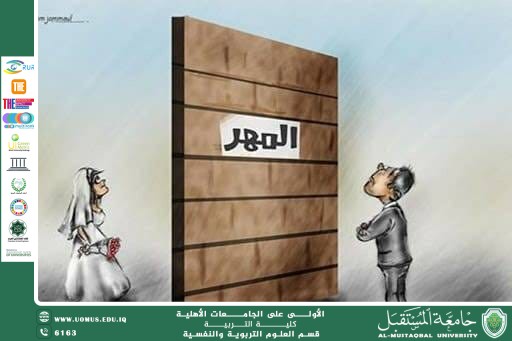
But can this tranquility be achieved if marriage becomes a business transaction, and the dowry becomes a major obstacle preventing young people from fulfilling their religious obligations and starting a family? This is what we will discuss today.
First: The Concept of Dowry in Islam (Between Ease and Excess):
The dowry is an exclusive right of the woman, ordained by God Almighty as an honor to her and an expression of the sincere desire to marry her.
God Almighty says: {And give the women their dowries as a free gift} [An-Nisa: 4]. The Prophet (peace and blessings be upon him) was keen to make this matter extremely easy, saying in the authentic hadith: “The best marriage is the easiest” (narrated by Ibn Hibban). In fact, he (peace and blessings be upon him) set a dowry for some of his noble companions that was almost negligible, such as an iron ring or teaching them verses from the Quran, emphasizing that a woman is married for her religion and character, not for her dowry.
Second: Reasons for the Escalation of Exorbitant Dowries in Our Societies:
Why have we begun to see these astronomical figures and exorbitant demands for dowries? We can attribute this to several reasons:
1. Exaggeration in Traditions and Customs: The dowry has transformed from a symbol of blessing and honor into a field for boasting. Social ostentation. Families now compete to raise dowries, saying, "Our daughter is worth so much."
2. The materialistic view of marriage: Marriage has become, in the minds of many, a purely "consumer project," burdening young men with expenses beyond their means, including preparations, housing, and furniture. The dowry is part of this purely materialistic system.
3. Blind imitation: Imitating celebrities or the wealthy in their daughters' dowries, without considering individual differences and each young man's economic circumstances.
4. Weak awareness-raising role of religious and media institutions: In establishing the concept of facilitating marriage and rejecting extravagance.
Third: The negative impact of exorbitant dowries (with a focus on spinsterhood):
Herein lies the crux of the matter, the devastating effect of this phenomenon, especially on women:
1. Depriving girls of the opportunity to marry (spinsterhood): When dowries reach exorbitant amounts, it narrows the circle of those who desire and are able to marry. Young men find themselves unable to provide this amount, so they flee from the responsibility of marriage or postpone it indefinitely. The direct result is 1. Large numbers of young women remain unmarried at home, despite their youth and desire for chastity and starting a family.
2. Delayed marriage for young men: Young men are forced to postpone marriage for many years to accumulate money, which may lead them to engage in harmful behaviors or deviant conduct, or at least endure a prolonged period of celibacy that can cause psychological distress.
3. The disintegration of families before they are even formed: How many engagements are broken and relationships severed due to disagreements over dowry details? How many genuine feelings are buried under piles of figures and financial demands?
4. The emergence of unequal marriages: Some parents may resort to marrying their daughters to men older or less suitable simply because they can afford exorbitant dowry demands. This rarely leads to a happy married life.
5. Burdening couples with debt: A young man who takes risks and borrows to cover the dowry and other expenses begins his married life burdened with debt and worries, negatively impacting the stability of his family and his life with his wife, turning tranquility and affection into anxiety. And fatigue.
Fourth: Solutions and Proposals:
How do we confront this problem? It is a collective responsibility:
1. Returning to the Prophetic Guidance: Scholars, preachers, and religious leaders should intensify their discussions on facilitating marriage, clarifying that exorbitant dowries have no basis in Islam, and that blessings lie in ease.
2. Raising awareness among families (especially parents): Parents must understand that exorbitant dowries do not elevate their daughters; rather, they hinder their happiness. The true dowry is the husband's good treatment and noble character. The Prophet (peace and blessings be upon him) said: "If someone comes to you whose character and religious commitment you approve of, then marry him. If you do not do so, there will be great corruption and mischief on earth."
3. Enacting Just Laws and Legislation: The state, represented by the Ministries of Justice and Religious Endowments, can set a maximum limit. Dowries should be commensurate with economic circumstances, as exemplified by Umar ibn al-Khattab (may God be pleased with him) when he addressed the people, saying: “Do not be excessive in the dowries of women. If it were a matter of worldly honor or piety before God, the Prophet (peace and blessings be upon him) would have been the first to do it. He did not give any of his wives, nor any of his daughters, a dowry exceeding twelve ounces of silver.”
4. The Role of the Media: Producing dramatic materials and awareness programs that highlight the real suffering of young men and women due to exorbitant dowries, and showcasing positive examples of affordable and successful marriages.
5. Civil Society Initiatives: Encouraging the establishment of charitable funds and associations to facilitate marriages for young people and contribute to preparing brides for marriage, thus alleviating the financial burden.
In conclusion:
The high cost of dowries is not just a men's issue; it is a women's issue as much as a men's. It is a societal issue.
Our focus on materialism and the restrictions placed on young men are the primary reasons why our young women remain unmarried. It is a loss of reward and a deprivation of future generations for the nation.
Let us reconsider our approach and stop making... Let's not turn marriage into a marketplace for commercial competition, but rather restore its dignity as a sacred human and religious bond founded on love, compassion, and mutual support. Let our motto be: Make things easy, not difficult.
(Al-Mustaqbal University is the leading university in Iraq)