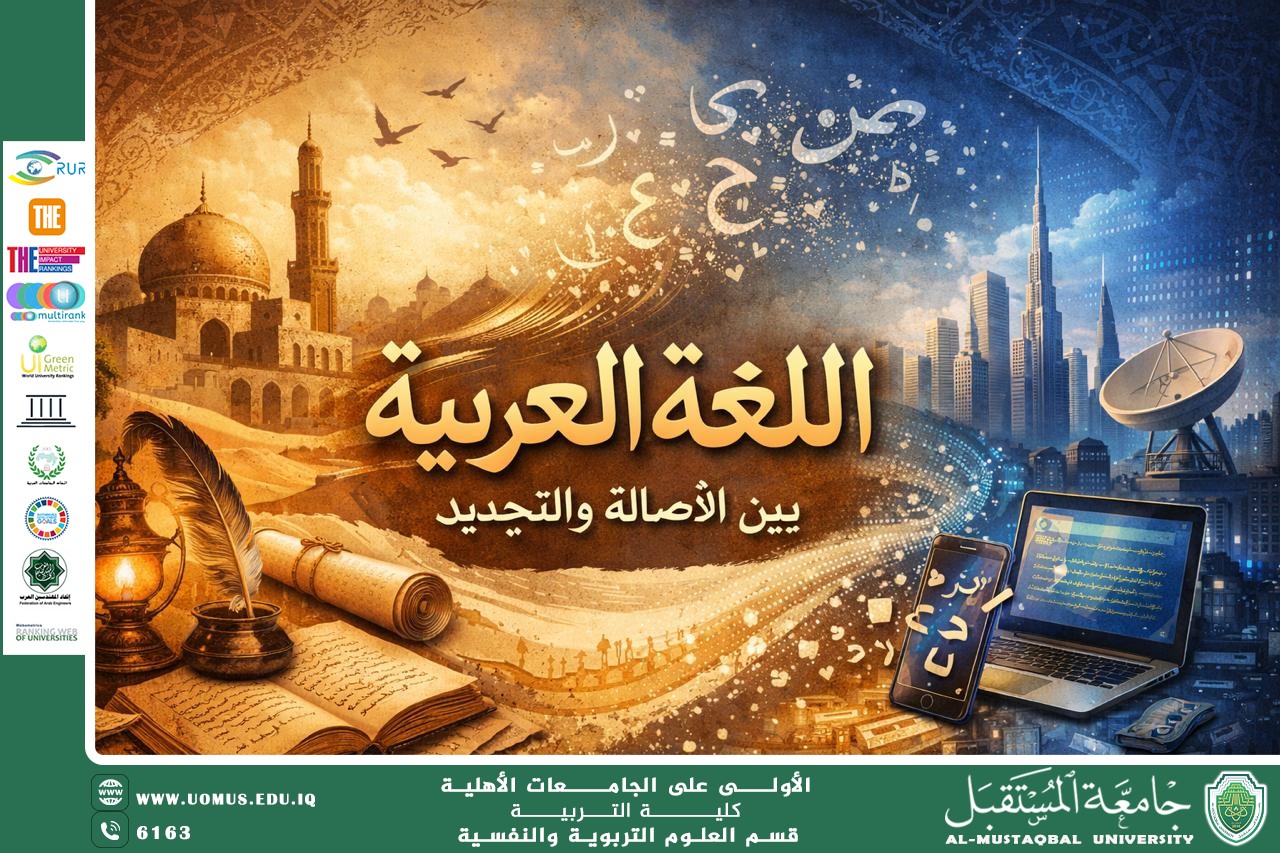
Arabic Language Between Authenticity and Renewal
Prepared by M.M. Likaa Abbas Daher
The Arabic language is one of the oldest living languages in the world, its history intertwined with that of Arab and Islamic civilization. For centuries, it served as a vessel for thought, literature, and science. Arabic gained its esteemed position as the language of the Holy Quran, which endowed it with textual and normative stability, preserving its phonological, morphological, and grammatical structures throughout the ages.
However, the stability of Arabic does not imply stagnation. It is a flexible language, capable of development, and it was able to absorb scientific and philosophical terminology during periods of cultural flourishing, such as the Abbasid era, when translation and authorship flourished. In the modern era, Arabic has faced the challenges of globalization and digital openness, highlighting the need to renew its terminological tools, develop its teaching methodologies, and integrate it with modern technologies.
The equation of authenticity and renewal represents the core of the contemporary dilemma. Preserving the integrity of the language does not contradict its development; rather, disciplined renewal within its established rules guarantees its continued vitality as a living language capable of keeping pace with cognitive transformations.
Among the manifestations of contemporary renewal in the Arabic language are the efforts exerted by language academies in Arabizing scientific and technical terminology and developing Arabic alternatives for foreign words, thus achieving openness to the world without compromising linguistic identity. Universities and research centers have also contributed to the development of modern linguistic studies, enabling a new understanding of the structure of Arabic in light of contemporary methodologies.
In the realm of education, it has become essential to reconsider methods of teaching Arabic, moving from rote memorization and passive learning to the development of communicative and analytical skills, and connecting the language to its real-life and technological contexts. Today's students live in a rapidly changing digital environment, necessitating the use of modern media in teaching Arabic, such as smart applications and interactive platforms, to enhance its presence in daily life.
In conclusion, the Arabic language is capable of combining its deep roots with its ever-evolving horizons. It is not merely a heritage to be preserved, nor simply a fleeting tool to be consumed, but a living entity that draws sustenance from its past to build its future. Therefore, the responsibility for preserving and developing it is a shared one among educational institutions, language academies, researchers, and indeed every speaker who believes it to be a vessel of identity and a mirror of culture.
(Al-Mustaqbal University is the first university in Iraq)