
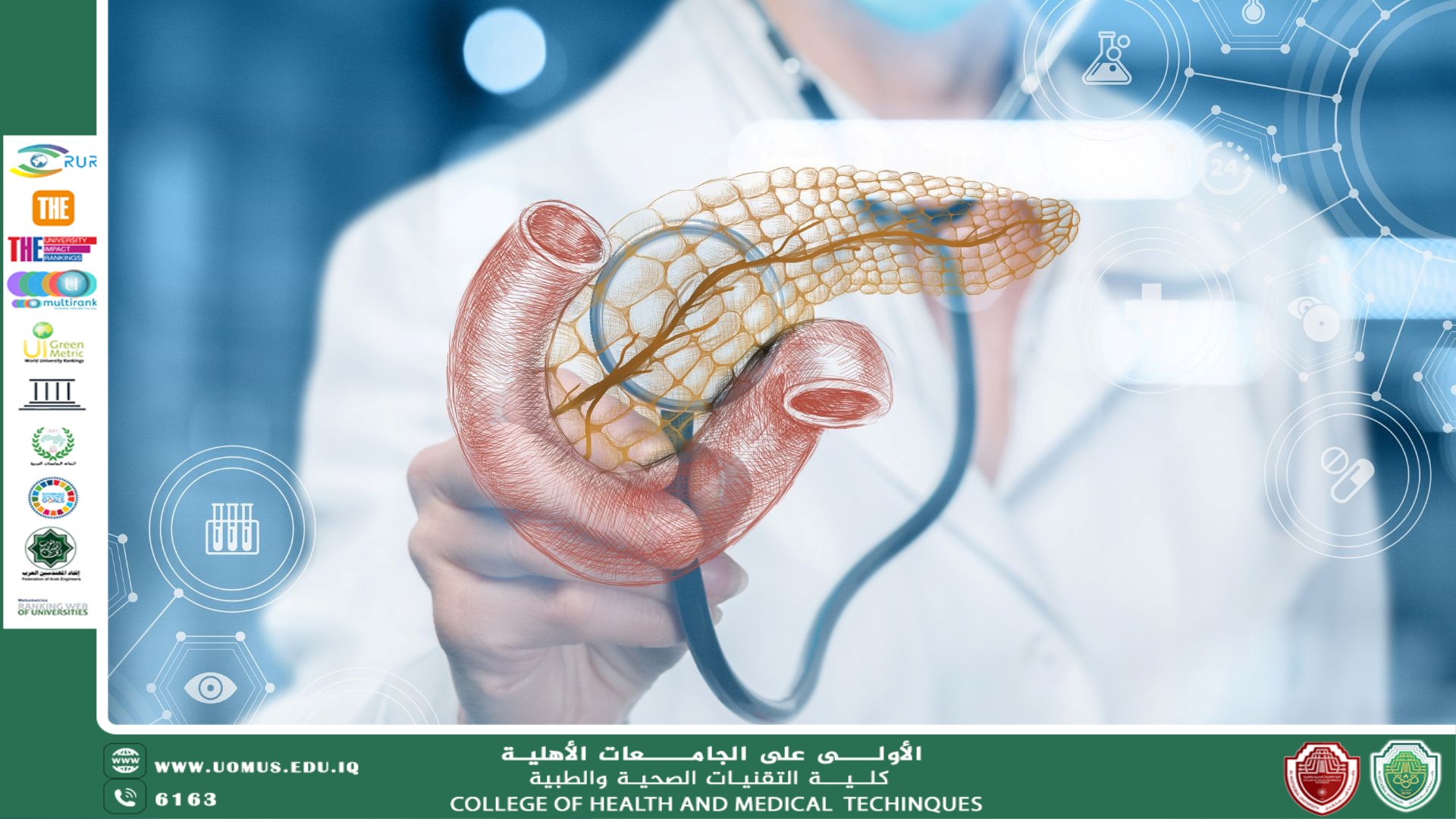
The Role of Ultrasound in Diagnosing Pancreatic Tumors: Efficiency and Accuracy in Medical Imaging
Dr . Kadhum Hashim Aljeafery
Introduction
Pancreatic cancer is one of the most lethal malignancies due to its high mortality rate and the difficulty of early detection. Early diagnosis is crucial for improving survival rates and reducing complications. In this context, medical ultrasound (sonography) has become a fundamental non-invasive diagnostic tool, offering high-resolution live imaging of internal organs, including the pancreas, quickly and safely.
Importance of Early Diagnosis
Early detection of pancreatic tumors allows for timely intervention before the tumor spreads or causes severe complications. Ultrasound helps physicians determine tumor size, location, and tissue characteristics, as well as assess surrounding blood vessels and the involvement of nearby organs. This information is essential for developing comprehensive treatment plans, including surgery, chemotherapy, or radiotherapy, enhancing treatment effectiveness and minimizing risks.
Mechanism of Ultrasound
Ultrasound utilizes high-frequency sound waves to create real-time images of internal organs. Sound waves pass through tissues and reflect at tissue boundaries, with the ultrasound device converting these echoes into visible images. Key advantages include the absence of ionizing radiation, rapid examination, and real-time visualization of the pancreas and surrounding tissues.
Advanced Ultrasound Techniques
Recent advancements in ultrasound technology have significantly improved diagnostic accuracy and efficiency, including:
Doppler Ultrasound: Evaluates blood flow around the tumor and its impact on nearby vessels.
3D Ultrasound: Provides precise three-dimensional images of the pancreas and tumor, aiding in anatomical visualization.
Contrast-Enhanced Ultrasound (CEUS): Uses safe contrast agents to detect small tumors and assess tissue vascularization.
Endoscopic Ultrasound (EUS): Combines ultrasound with endoscopy for high-precision imaging of deep pancreatic structures and enables targeted tissue biopsy.
Combining Ultrasound with Other Imaging Modalities
While ultrasound is highly effective, combining it with CT scans or MRI enhances diagnostic certainty and provides a precise tumor map before surgery or therapy. Multidetector CT (MDCT) offers high-resolution images and additional information about lymph nodes and blood vessels.
Clinical Applications
Ultrasound is used in various clinical scenarios related to pancreatic tumors, such as:
Monitoring tumor progression and patient response to therapy.
Assessing obstruction of bile or pancreatic ducts caused by the tumor.
Detecting small tumors not visible on conventional imaging.
Guiding precise tissue biopsies to ensure accurate sampling.
Challenges and Limitations
Despite its advantages, ultrasound has limitations, including:
Difficulty imaging obese patients or those with intestinal gas.
Heavy reliance on the physician’s experience in interpreting images.
Limited ability to assess complex or very small tumors in certain cases.
Future Directions
Recent research suggests that integrating artificial intelligence (AI) with ultrasound can significantly enhance diagnostic accuracy by automatically analyzing images and detecting patterns invisible to the human eye. The development of portable ultrasound devices also enables examinations in small hospitals or remote areas, increasing early detection rates and improving treatment outcomes.
Conclusion
Ultrasound remains an essential tool for diagnosing pancreatic tumors due to its accuracy, speed, and safety. Continuous advancements in technology, combined with effective training for medical personnel, improve diagnostic quality, support treatment planning, and enhance healthcare outcomes for patients with pancreatic tumors.