Microarray Technology: A Powerful Tool for Gene Expression Analysis Prepared by: Assist. Lect. Abbas Hamza Khudhair Department of Biochemistry – College of Science – Al-Mustaqbal University
Microarray technology (DNA Microarray) is an advanced molecular technique used to analyze gene expression and study thousands of genes simultaneously within a single experiment. It has played a transformative role in genomics, molecular medicine, and biomedical research.
Principle of the Technique
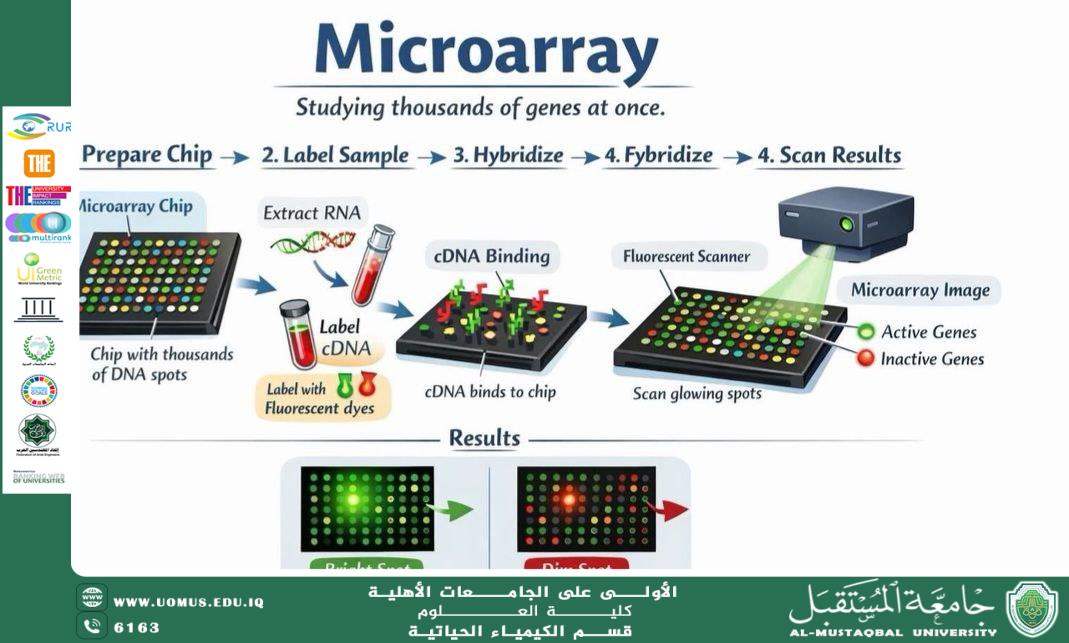
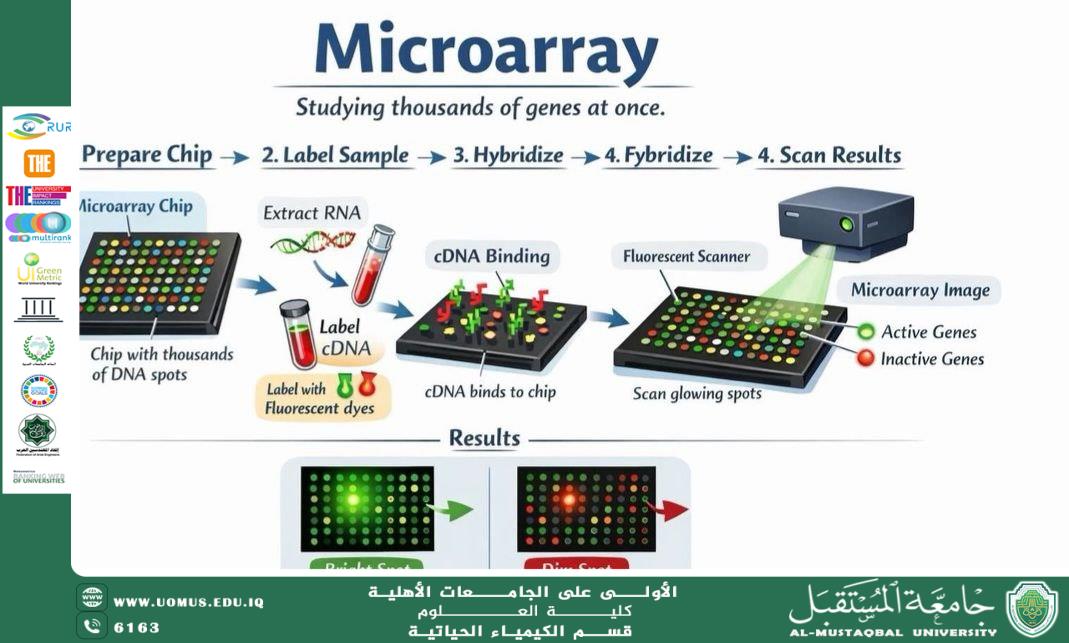
Microarray technology is based on the immobilization of thousands of specific DNA probes on a small glass slide. RNA is extracted from a biological sample (such as tissue or cultured cells) and converted into complementary DNA (cDNA), which is then labeled with fluorescent dyes.
When the labeled cDNA is applied to the microarray slide, complementary hybridization occurs between the sample sequences and the fixed probes. The fluorescence intensity is measured using a scanner, and the signal corresponds to the level of gene expression.
Major Applications
Gene expression profiling in cancer research
Comparison between normal and diseased tissues
Identification of genetic mutations and polymorphisms
Discovery of diagnostic and prognostic biomarkers
Research Significance
Microarray technology enables large-scale parallel gene expression analysis, providing comprehensive insight into molecular changes associated with disease. Although next-generation sequencing approaches such as RNA-Seq have become more widely used, microarrays remain a cost-effective and efficient tool for many comparative and high-throughput studies.
Conclusion
Microarray technology represents a fundamental platform in functional genomics and molecular diagnostics. It has significantly contributed to our understanding of gene regulation and continues to support research in precision medicine and translational science.
Al-Mustaqbal University – Ranked First Among Iraqi Private Universities