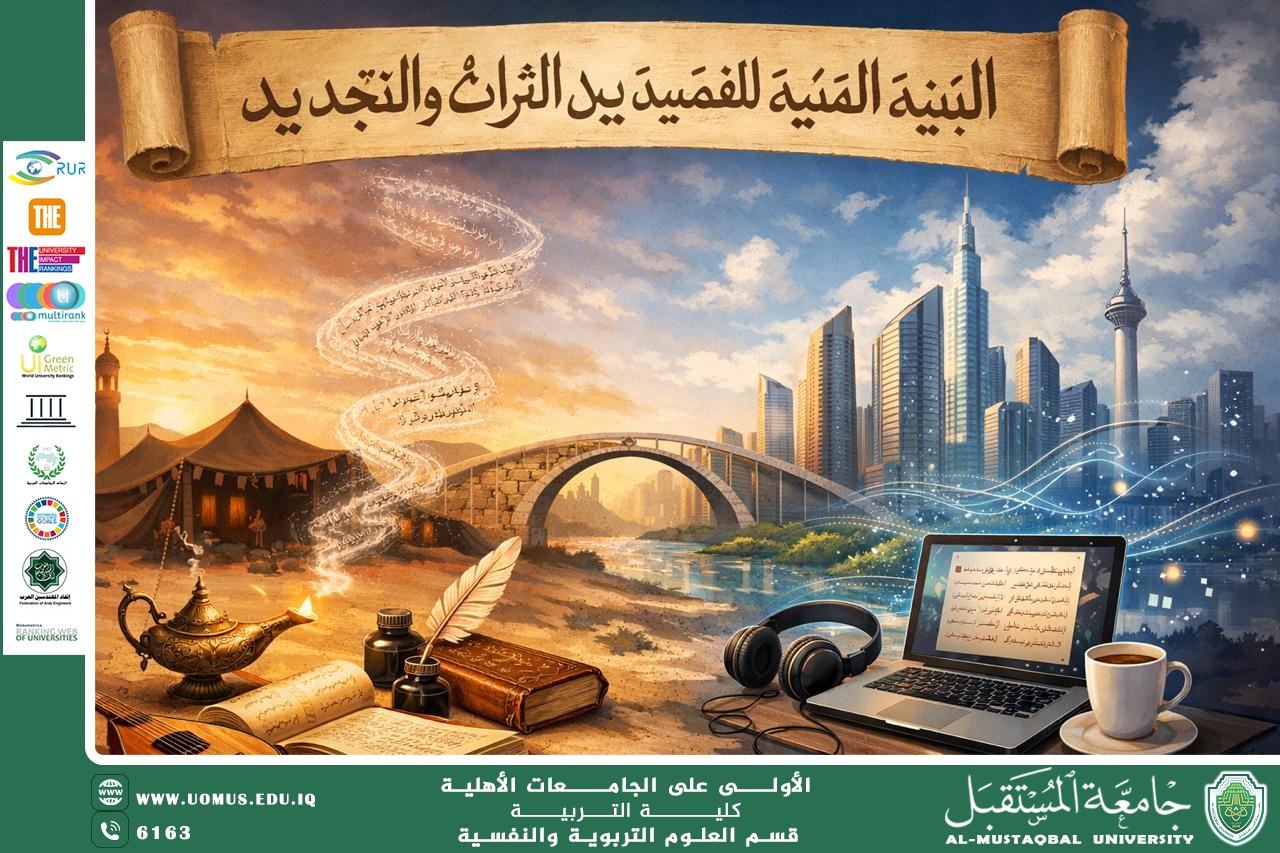
The Artistic Structure of the Arabic Poem: Between Tradition and Renewal
The Arabic poem is one of the oldest art forms that has expressed the Arab consciousness, serving throughout the ages as a living record of its intellectual, social, and cultural transformations. Poetry was not merely a means of aesthetic expression, but rather the Arabs' record, the vessel of their history, and the platform for their values. Hence, the study of the artistic structure of the Arabic poem has acquired particular importance, as it reveals the nature of the transformations that poetry has undergone between the stability of tradition and the spirit of renewal.
The Arabic poem, in its traditional form, was based on a precise artistic structure, manifested in the unity of meter and rhyme, according to the prosodic system established by Al-Khalil ibn Ahmad al-Farahidi. This system imparted a regular musicality that contributed to establishing rhythm as an essential element in the composition of poetry. The classical poem was also characterized by the richness of its language, the strength of its composition, and the clarity of its rhetorical imagery based on simile, metaphor, and metonymy. This is clearly evident in the poetry of Al-Mutanabbi, who combined the grandeur of expression with the depth of meaning, to the point that his poems became a model of cohesive poetic structure. The artistic structure of classical Arabic poetry was not limited to rhythm; it encompassed a thematic system based on multiple purposes within a single poem. For example, a pre-Islamic poem might begin with lamenting the ruins of abandoned dwellings, then move to love poetry, followed by boasting or praise, reflecting the nature of the poetic vision of that era.
However, the twentieth century witnessed profound transformations in the structure of Arabic poetry as a result of intellectual and social changes and the influence of Western critical currents on writers. This led to the emergence of free verse, spearheaded by poets such as Nazik al-Mala'ika and Badr Shakir al-Sayyab. In this movement, the poem was liberated from the two-hemistich system and the single rhyme scheme, while still retaining the metrical foot as a flexible rhythmic unit. This transformation represented a qualitative leap in the concept of rhythm, making it more diverse and harmonious with emotional experience.
With the development of poetic modernism, some poets turned to prose poetry, which relied on internal rhythm and complex imagery instead of traditional meter. Poetic imagery also evolved from being directly sensory to becoming symbolic, drawing inspiration from myth, history, and cosmic symbols. This is evident in the poetry of Mahmoud Darwish, where national and humanistic symbols intertwine in a profound semantic structure.
Another prominent manifestation of renewal is the shift of the poem from multiple purposes to a unified theme or experience, thus expressing a comprehensive vision that reflects the anxieties of modern man and his existential questions. However, this transformation was not a break with tradition, but rather a reshaping of it in light of contemporary realities. Awareness of Arabic rhythm remained present, even in the most liberated poetic forms, and traditional symbols continued to be a source of inspiration for contemporary poets.
The artistic structure of the Arabic poem reveals an ongoing dialectic between authenticity and innovation. Arabic poetry has not abandoned its roots, but has reformulated them with a new language and vision. This confirms that true renewal does not mean separation from the past, but rather dialogue with it and reinterpretation in a way that aligns with the transformations of the present.
Thus, the Arabic poem remains an open space for aesthetic experience, capable of evolving without losing its identity, and qualified to continue its contributions to the contemporary literary scene.
(Al-Mustaqbal University is the first university in Iraq)