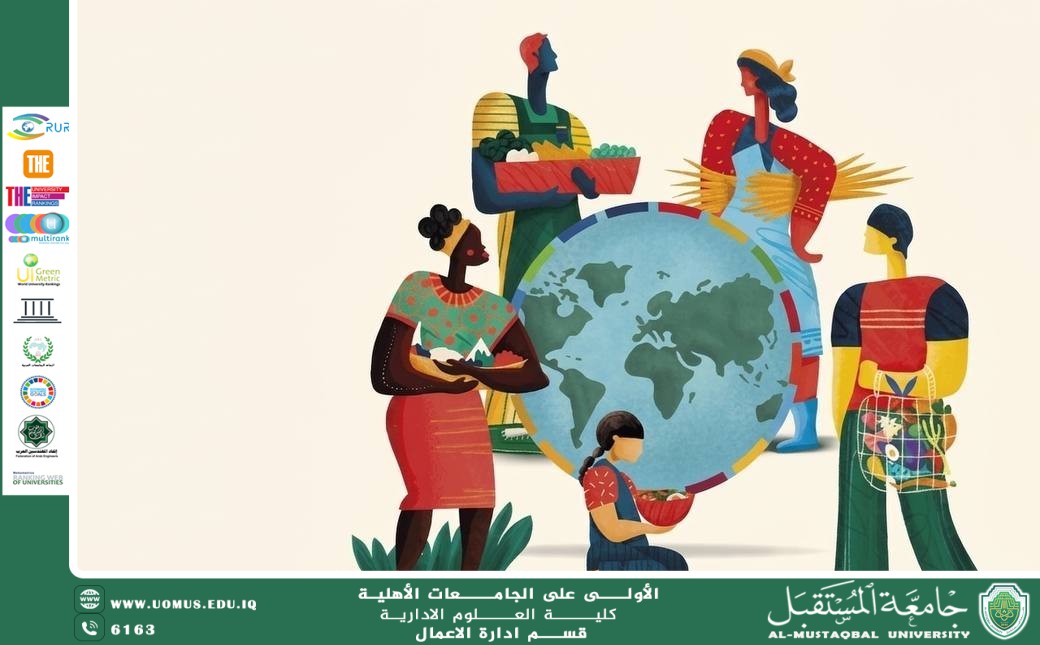

Why Producing Food Alone Is Not Enough? The Role of Responsible Consumption in Achieving a World Without Hunger
Prepared by: Professor Dr. Haider Ali Al-Dulaimi
College of Administrative Sciences
Many people believe that solving the problem of hunger in the world depends only on increasing food production. Although agricultural production has witnessed significant development over the past decades, the problem of hunger still persists in many regions of the world. This indicates that the issue is not merely the quantity of food produced, but also the way it is distributed, consumed, and managed. Therefore, it has become essential to consider the concept of responsible consumption as a fundamental part of the solution.
The United Nations addresses these global challenges through the Sustainable Development Goals (SDGs). Among the most prominent are Goal 2: Zero Hunger, which focuses on ensuring that all people have access to sufficient, safe, and nutritious food, and Goal 12: Responsible Consumption and Production, which encourages reducing waste and improving the efficient use of resources.
In fact, many reports indicate that a large proportion of the food produced globally is lost or wasted at different stages of the food supply chain, whether during harvesting, transportation, storage, or even in households and restaurants. This waste does not only represent an economic loss, but also means the squandering of natural resources such as water, energy, and agricultural land that were used to produce this food.
Here comes the role of responsible consumption, which is based on using resources in a conscious and balanced manner. When individuals make an effort to purchase appropriate quantities of food, store it properly, and reuse surplus food, they contribute to reducing food waste. Communities can also support initiatives that aim to redistribute surplus food to those in need instead of discarding it.
Moreover, supporting local products and sustainable agriculture contributes to reducing transportation costs and protecting the environment, while also helping local farmers improve their income and maintain their production. All these efforts contribute to building a more just and sustainable food system.
In conclusion, eliminating hunger does not rely solely on producing more food; it also requires changing consumption behaviors and managing food resources more effectively. When individuals and societies act with awareness and responsibility in dealing with food, we can move closer to achieving a world free of hunger, where food is available for everyone without waste or depletion of the planet’s resources.