
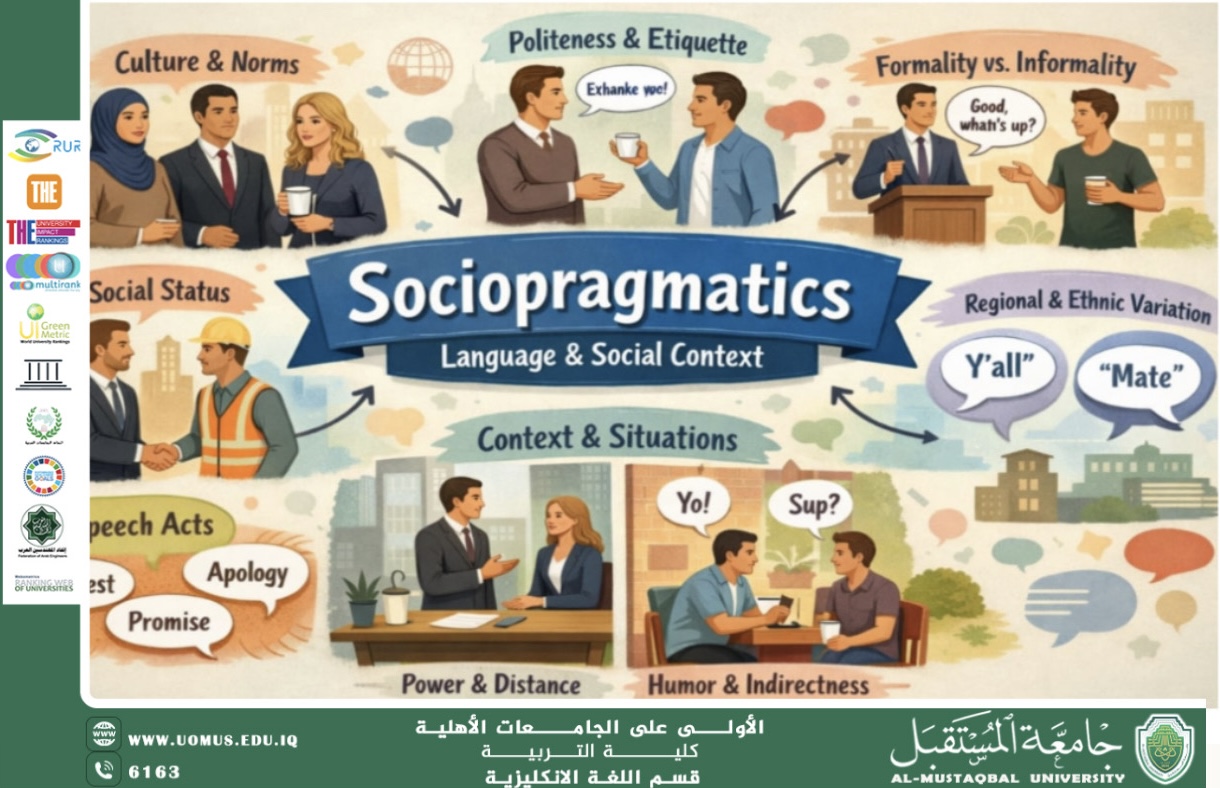
Socio-pragmatics
Socio-pragmatics, as (Angermuller et al., 2014, p. 259) mentions, is an approach of analyzing language and speech. Leech (1983) was one of the first linguists to recognize socio-pragmatics as a significant component of general pragmatics (see Figure 1). He defines general pragmatics as "the general conditions of the communicative use of language". He divides it into two categories :pragmalinguistics and socio-pragmatics. The former refers to pragmatics' linguistic component, which consists of "the particular resources that a given language provides for conveying particular illocutions," i.e., the pragmatics-grammar interaction. The latter relates to the interaction between pragmatics and sociology or the "sociological interface of Pragmatics."
Pragmalinguistics is the interface between linguistics and pragmatics, according to Richards and Schmidt (2002), focusing on the linguistic approaches used to achieve pragmatic aims, such as asking how to convey a compliment in a certain language. In contrast, socio-pragmatics is concerned with “the relationship between social factors and pragmatics”.
For example, to introduce the conditions and techniques that can be used for creating compliments in that While Stranzy (2005) defines Pragmalinguistics as "the structural resources of language." Socio-pragmatics is concerned with language use, whereas Sociolinguistics is concerned with language use and "relative social situations" (pp. 870 - 872).
Furthermore, socio-pragmatics, according to Aijmer and Andersen (2012, pp.2-3) is "the study of language and communication in its social and cultural context,". Its main purpose is to show how social and cultural factors impact pragmatic tactics "as manifested through language forms in certain communication circumstances."
Socio-pragmatics examines how situational circumstances shape and change the norms that speakers utilize, and it may connect with other social sciences such as Critical Discourse Analysis (henceforth CDA) and Sociolinguistics (Angermuller et al., 2014, p. 259).
Sociopragamtics here, includes numerous "societal viewpoint studies to pragmatics" such as interactional sociolinguistics, variational pragmatics, linguistic anthropology, CDA, and other related topics. This discipline is concerned with how language forms may represent social or situational qualities due to its strong relationship with certain contexts or situational factors.
According to Schmitt (2002, p. 80), Socio-pragmatic approaches emphasis on the socially grounded judgments, attitudes, and interactional principles that "underlie people's choice of strategies." To summarize, Understanding the connected relationship between language and its social environment, in which social variables or circumstances play a major role, is a cornerstone in socio-pragmatics.
M. M. Tabarak Alaa Fouad
جامعة المستقبل الاولى في العراق