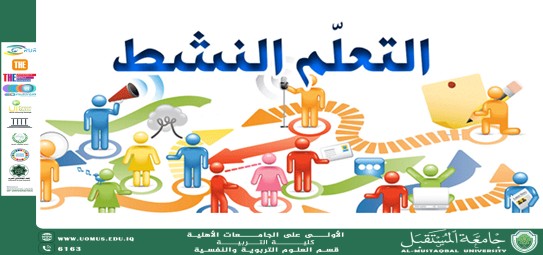

Active Learning and Its Role in Developing Students' Higher-Order Thinking Skills
Prepared by M.M. Amal Mohammed Jaber
Introduction
Education in the modern era is witnessing fundamental transformations as a result of rapid scientific and technological advancements. This has necessitated a re-evaluation of traditional teaching methods that rely on rote learning and memorization. The concept of active learning has emerged as a modern educational trend that focuses on making the learner the center of the educational process by actively engaging them in various learning activities. This learning style contributes to developing students' intellectual abilities, particularly higher-order thinking skills such as analysis, synthesis, evaluation, and creativity. These skills are essential for meeting the challenges of our time and building a learner's personality capable of independent thinking and problem-solving.
First: The Concept of Active Learning
Active learning refers to a set of educational strategies that focus on students' active participation in the learning process through discussion, group work, problem-solving, and project-based learning. This approach aims to transform the student's role from a passive recipient of information to an active participant in constructing knowledge.
Active learning is characterized by several features, most notably:
Student engagement in diverse educational activities.
Encouraging dialogue and discussion within the classroom.
Promoting collaborative learning and teamwork.
Linking theoretical knowledge to practical application.
Developing students' thinking and inquiry skills.
Second: The Concept of Higher-Order Thinking Skills
Higher-order thinking skills are complex mental processes that go beyond memorization and recall. They include advanced cognitive processes such as analysis, deduction, evaluation, and creativity. These skills are essential for developing a learner's personality, enabling them to confront problems and make appropriate decisions.
Among the most important higher-order thinking skills are:
Analysis: The ability to break down information into its basic components and understand the relationships between them.
Synthesis: The ability to integrate ideas and information to produce new knowledge.
Evaluation: Making judgments based on specific criteria.
Problem-solving: Using prior knowledge and experience to find suitable solutions to various problems.
Creative thinking: Generating new and innovative ideas.
Third: The Importance of Active Learning in the Educational Process
Active learning is an effective teaching method that contributes to improving the quality of education. It helps students understand the subject matter more deeply. It also enhances motivation to learn and increases student interaction within the classroom. The importance of active learning is evident in several aspects, including:
Developing students' critical and creative thinking.
Increasing the level of interaction and participation within the classroom.
Boosting students' self-confidence.
Developing communication and teamwork skills.
Improving the ability to apply knowledge in real-life situations.
Fourth: The Role of Active Learning in Developing Higher-Order Thinking Skills
Active learning directly contributes to developing students' higher-order thinking skills through a range of educational activities and strategies that encourage students to think, analyze, and draw conclusions.
Among the most prominent roles of active learning in this area are:
Enhancing Analytical Thinking:
Through activities that require students to analyze and discuss information, such as case studies or analyzing educational problems.
Developing Critical Thinking:
Active learning encourages students to ask questions, discuss different ideas, and evaluate presented opinions and arguments.
Developing Problem-Solving Skills:
Students encounter educational situations that require them to search for appropriate solutions, thus developing their ability to think logically.
Developing Creative Thinking:
Through activities that rely on generating new ideas, such as brainstorming and educational projects.
Promoting Self-Learning:
Active learning encourages students to seek information independently, contributing to the development of their independent thinking skills.
Fifth: Active Learning Strategies for Developing Thinking Skills
There are many strategies that can be employed within the framework of active learning to develop higher-order thinking skills, most notably:
Cooperative Learning: where students work in small groups to achieve a common learning objective.
Brainstorming: which aims to generate as many ideas as possible about a specific topic.
Problem-Based Learning: where students are required to analyze a real-world problem and propose solutions.
Project-Based Learning: which encourages students to research and investigate to produce a scientific project.
Classroom Discussion: which allows students to exchange opinions and ideas and develop critical thinking skills.
Sixth: The Teacher's Role in Implementing Active Learning
The teacher plays a pivotal role in the successful implementation of active learning in the classroom, as their role shifts from a transmitter of information to a facilitator of the learning process. The teacher's role in this context includes:
Designing thought-provoking educational activities.
Encouraging student participation and interaction.
Guiding classroom discussions constructively.
Providing a supportive learning environment.
Assessing student performance using diverse methods that consider thinking skills.
Seventh: Challenges Facing the Implementation of Active Learning
Despite the importance of active learning, its implementation may face some challenges, including:
Large class sizes.
Limited time allocated for lectures.
Insufficient training for some teachers in active learning strategies.
Reliance on traditional assessment methods that focus on memorization.
Conclusion
In light of the above, it is clear that active learning represents one of the modern educational methods that contributes to developing the educational process and enhancing students' intellectual abilities. It helps develop higher-order thinking skills, promotes student participation in learning, and makes the educational process more effective and enjoyable. Hence, the importance of educational institutions, especially colleges of education, adopting this teaching method, while providing appropriate training for teachers and developing assessment methods that align with the requirements of contemporary education, becomes evident.
(Al-Mustaqbal University is the first university in Iraq)