Scientific Article for Asst. Lecturer Haider Mutlak Mousa Gas Chromatography and Its Applications
After vaporization, the sample enters the chromatographic column, which is usually a long coiled tube internally coated with a stationary phase responsible for separating the compounds.
The column is placed inside a temperature-controlled oven that maintains optimal thermal conditions for the separation process. Temperature control is crucial because it affects the volatility of compounds and their movement through the column. Proper temperature programming allows efficient separation of complex mixtures.
Once the separated compounds leave the column, they pass through a detector. The detector identifies the compounds and converts their presence into electrical signals. These signals are then recorded by a computer and displayed as a chromatogram, which is a graphical representation showing peaks corresponding to different compounds in the sample.
Several detectors are commonly used in gas chromatography. The flame ionization detector (FID) is widely used for detecting organic compounds due to its high sensitivity and reliability. Another detector, the electron capture detector (ECD), is particularly useful for detecting halogenated compounds and environmental pollutants.
Gas chromatography has a wide range of applications in scientific research and industry. It is used in environmental analysis to detect pollutants in air and water, in petrochemical industries to analyze fuel composition, and in pharmaceutical and food industries for quality control. It is also used in forensic laboratories to identify drugs, toxic substances, and other chemical residues in biological samples.
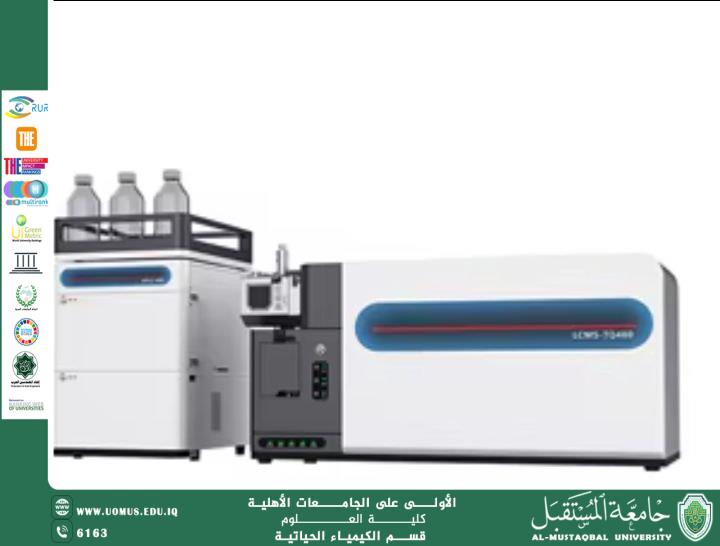
Advances in analytical technology have led to the development of combined systems such as GC–MS (Gas Chromatography–Mass Spectrometry), which provide highly accurate identification of chemical compounds.
Al-Mustaqbal University, the leading private university in Iraq