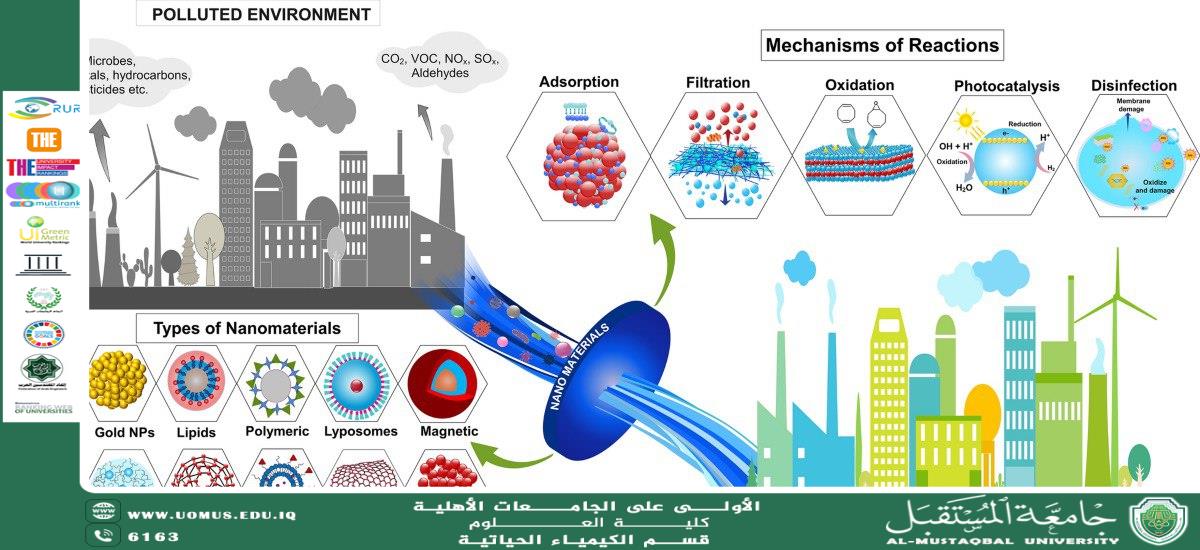

Scientific Article by Ass .Prof. Mustafa Ali Al-Awadi Department of Biochemistry Title Smart Nanosensors for Real-Time Environmental Pollution Monitoring
Environmental pollution has become one of the most pressing global challenges due to rapid industrialization, agricultural activities, and urban expansion. Monitoring environmental quality is therefore essential for protecting ecosystems and human health. In recent years, smart nanosensors have emerged as one of the most promising innovations in environmental analytical chemistry, offering highly sensitive and rapid methods for detecting pollutants in air, water, and soil in real time.
Nanosensors are based on nanomaterials that possess unique physical and chemical properties, particularly their extremely large surface area and high chemical reactivity. These characteristics enable strong interactions between the sensing material and pollutant molecules. Materials such as graphene, carbon nanotubes, and metal oxide nanoparticles are commonly used in the fabrication of nanosensors due to their excellent electrical and catalytic properties. As a result, these sensors can detect extremely low concentrations of environmental contaminants, sometimes at levels as low as parts per billion (ppb).
The working principle of nanosensors typically involves converting the chemical interaction between the nanomaterial and the target pollutant into a measurable signal. This signal may be electrical, optical, or fluorescent depending on the design of the sensing system. Advances in electronics and digital technologies have enabled these sensors to be integrated with wireless communication systems and Internet of Things (IoT) networks, allowing environmental data to be transmitted instantly to monitoring centers for analysis and decision-making.
One of the most important advantages of smart nanosensors is their ability to provide continuous and real-time environmental monitoring without the need for complex laboratory analysis. Traditional analytical methods often require sample collection, transportation, and time-consuming laboratory procedures. In contrast, nanosensor-based systems can deliver immediate measurements directly in the field, enabling rapid responses to pollution events and improving environmental management strategies.
These sensors have already shown great potential in monitoring air quality and detecting hazardous gases such as carbon monoxide, nitrogen oxides, and other volatile organic compounds. In addition, nanosensors are increasingly used for detecting heavy metals, pesticides, and toxic organic substances in water sources. Ongoing research is also focused on developing nanosensors capable of operating efficiently in harsh environmental conditions such as industrial zones or highly contaminated sites.
Overall, smart nanosensors represent a significant advancement in environmental monitoring technologies. By combining high sensitivity, rapid response, and field-deployable capabilities, these systems are expected to play a crucial role in future environmental protection strategies and contribute to achieving global sustainability and pollution control goals.