Sam Shepard and August Wilson: Dramatic Visions of Postmodernism and Ontology
Assistant Professor Dr. Mamoun Sami Saleh on the Self and Art in the Postmodern Era
In his article, Dr. Mamoun Sami Saleh addresses the transformations experienced by humans in the postmodern era, noting that individuals increasingly live in a state of fragmentation and doubt due to rapid social and cultural changes, making the formation of a coherent identity difficult. He emphasizes that the self is no longer the integrated entity characteristic of the modern era but has become a fragmented experience influenced by media symbols and images, reflecting internal ambiguity and difficulty in expression and communication.
Dr. Saleh points out that postmodern art clearly reflects this condition. While modernist artists sought innovation and artistic purity, postmodern artists adopt an eclectic approach, combining diverse elements from the past and different cultures to produce works open to interpretation, transcending the traditional boundaries between high and popular culture, and questioning grand narratives and established historical assumptions.
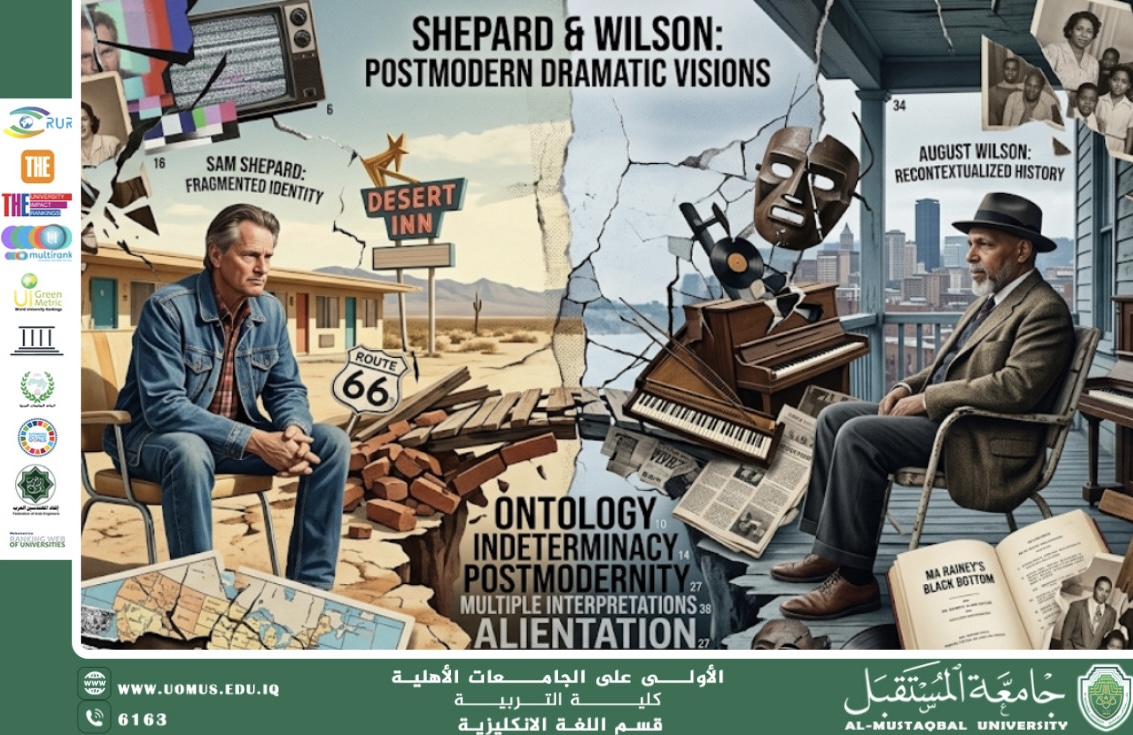
Dr. Saleh adds that postmodern theater, as seen in the works of Sam Shepard and August Wilson, presents clear depictions of alienation and identity crises, where the search for meaning becomes central to the dramatic experience. Through experimentation with language, character construction, and dramatic structure, theater becomes a space for exploring ambiguity, continuous change, and the complexities of human existence.
Dr. Mamoun Sami Saleh concludes that postmodernism represents a new philosophical and cultural condition, where ambiguity replaces certainty, fragmentation replaces unity, and continuous transformation replaces stability, revealing the contemporary self as a complex entity shaped by accumulated experiences, memories, and diverse cultural influences.
لمعرفه المزيد من التفاصيل حول هذه المقال اضغط هنا